

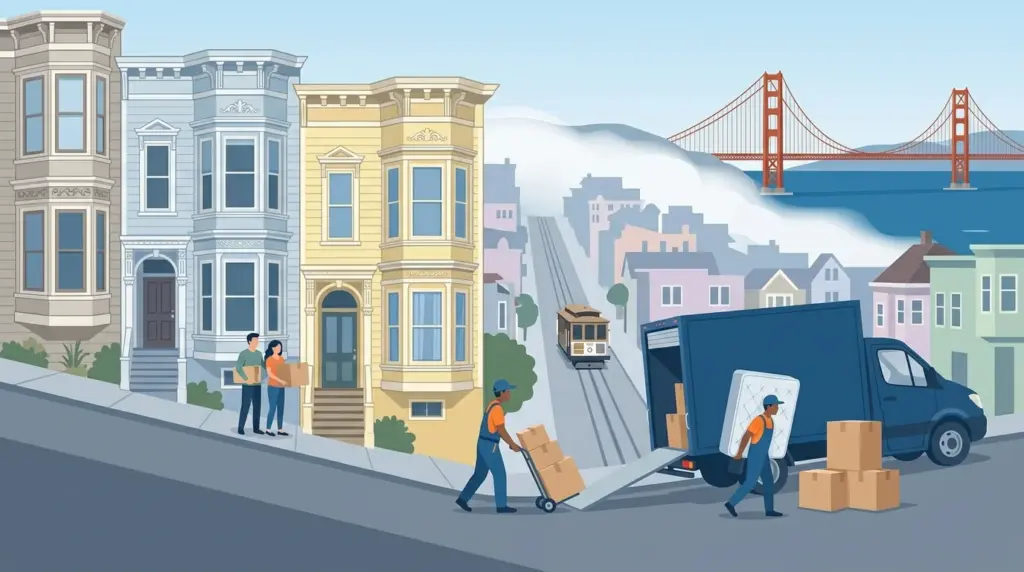
A San Francisco move is won or lost at the address level
San Francisco offers dense neighborhoods, strong transit in many areas, cultural depth, and access to the wider Bay Area. It also asks newcomers to make careful tradeoffs among space, housing cost, hills, parking, commute direction, and the physical path into the home.
The right starting point is a short list of real properties, not a citywide average. Walk the block, test the weekly trips, read the lease or ownership costs, and show the moving provider the exact curb-to-room route. Those details reveal whether an attractive address is genuinely workable.
Decide whether San Francisco works for everyday life
Decide how the household will move through the city and region before paying for housing. A smaller home near the right transit or job connection may produce a better daily life than more space that adds transfers, driving, parking, or a difficult hill.
Continue through the relevant Moveline guides: Cost to Move from San Francisco to Denver in 2026 · Los Angeles–San Francisco Moving Cost in 2026: Both Directions · New York–San Francisco Moving Cost in 2026: Both Directions · San Francisco to Seattle Moving Cost (2026 Guide) · Moving Guides by City · Moving to California.
What San Francisco housing numbers mean for your budget
San Francisco is expensive even though its rent-burden share is lower than the national share. The $2,476 ACS gross-rent median is historical and combines all occupied rental sizes; the 39.6% burden statistic reflects local incomes as well as rent. Neither number means a particular household will find the city affordable.
Use current same-bedroom listings and add utilities, required fees, parking if needed, insurance, deposits, and transportation. Buyers should treat the $1,394,500 historical value median as a sign that financing and address choice need rigorous testing, then use current prices, taxes, insurance, condition, seismic considerations, and the household’s own income.
For a narrower housing question, use: San Francisco affordable-neighborhood guide · short-term housing location guide.
How your starting point changes a move to San Francisco
The table spans western regional origins such as Portland and Seattle through long cross-country moves from Chicago, New York City, and Boston. The farther moves make delivery range and temporary living more important; every origin still needs a specific San Francisco curb and building plan.
Straight-line entries organize route scale but cannot predict truck routing or timing. Give the carrier both addresses, stairs and elevators, reservation windows, parking restrictions, and the household’s acceptable delivery range. Use the linked route guides for corridors with deeper coverage.
Detailed route guides already available: San Francisco–Denver moving-cost guide · San Francisco–Seattle moving-cost guide.
Build a complete San Francisco moving budget
Ask every provider to price the same inventory, dates, origin access, and San Francisco delivery conditions. For a San Francisco move, also add the work that remains with you: packing, driving or airfare, meals, lodging, parking, storage, and time away from work. A lower transportation charge does not improve the San Francisco plan if it moves expensive tasks outside the estimate.
San Francisco makes access part of the service scope. Compare estimates only after every provider has the same curb, hill, stair, elevator, carry, shuttle, and building-window facts; otherwise the lowest total may simply contain the largest unresolved access charge.
Use these planning tools with the same inventory and dates: best-time-to-move guide · Moveline moving-cost planning guide · moving-company verification checklist.
Prepare the address and arrival in San Francisco
Resolve curb legality, parking restrictions, building hours, elevator reservations, insurance certificates, stairs, hills, and the full carry before the estimate is final. If a smaller shuttle vehicle may be needed, ask who decides, how it is priced, and how the goods are transferred.
Take possession and document the home before delivery. Have utilities, keys, building contacts, and a protected indoor space for essentials ready. A long-distance household should carry enough daily supplies to live and work while waiting through the agreed delivery range.
Bring the San Francisco plan together
A strong San Francisco plan connects one suitable home, a realistic weekly routine, a comparable moving scope, and a confirmed delivery path. Once those San Francisco pieces agree, the checklist becomes a schedule rather than a collection of unanswered questions.
Questions people ask before moving to San Francisco
Sources
- U.S. Bureau of Labor Statistics Local Area Unemployment Statistics
- U.S. Census Bureau 2020–2024 American Community Survey 5-Year Data
- U.S. Census Bureau Vintage 2025 City and Town Population Estimates
- U.S. Census Bureau TIGERweb Place Internal Points
- FMCSA: Estimating Charges
- FMCSA: Plan Your Move
- IRS Statistics of Income County-to-County Migration Data
- OpenStreetMap-Based Heavy-Vehicle Route Model
- U.S. Census Bureau: Gross rent definition