

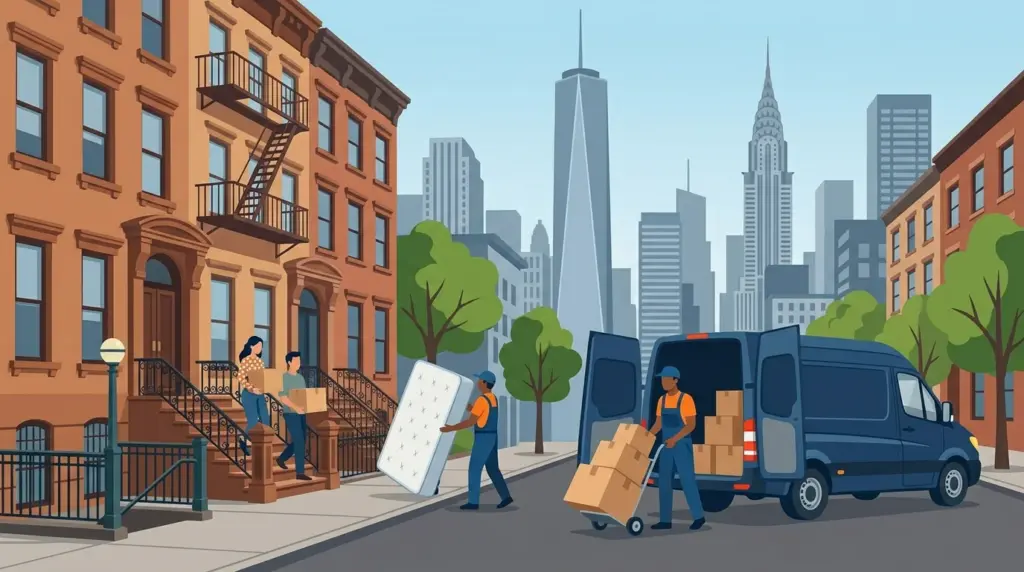
Moving to NYC is two decisions tied together. First, you have to choose a home that makes your daily life work; then you have to get a truck, crew, and apartment building through the same narrow arrival window. A lower rent can be a poor bargain if the trip to work requires unreliable transfers, while a perfect apartment can become an expensive move if the building has no elevator slot or the truck cannot load near the entrance.
This guide helps you solve both decisions. It compares borough and neighborhood patterns, explains how education opportunities can affect the address, covers the cash and documents commonly needed before keys, and shows how transit, curb signs, truck routes, elevators, and building rules change the move. For a long-distance arrival, it uses useful road approaches because point-to-point mileage cannot show what will happen at the destination building.
Summer 2026 captures the city’s appeal and its pressure unusually well. The Knicks won their first NBA championship since 1973 in June, setting off a celebration decades in the making. At the same time, the mayor’s office describes a rental vacancy rate of only 1.4%. The energy is real, but so is the competition for a workable apartment.
Choose the daily trip before choosing the apartment
Start with the place you must reach most often: an office, school, hospital, family member, or childcare provider. Test the complete door-to-door trip at the hours you will actually travel. The closest subway entrance does not tell you whether you need two transfers, whether the useful entrance is accessible, or how service changes at night and on weekends.
In January 2026, the subway and local-bus base fare rose to $3. The MTA also stopped selling MetroCards and is completing the change to OMNY during 2026, according to its 2026 fare update. Use the same contactless card, phone, or OMNY card for each tap, and check the MTA’s current fare instructions if you still have a MetroCard. If stairs are difficult or you will regularly carry a stroller, bicycle, or equipment, use the accessible-station list and check elevator status rather than assuming a station icon guarantees a working elevator that day.
Also identify the fare system you will use. PATH, NYC Ferry, the Staten Island Ferry, Long Island Rail Road, and Metro-North are not interchangeable with the subway just because they appear on the same map. A neighborhood may be convenient only if you understand the price, schedule, transfer, and late-night limits of its actual service.
Education opportunities can change the best address
The city’s educational reach extends from neighborhood public schools to research universities, art conservatories, community colleges, technical training, and free adult classes. That breadth is a real reason to move here, but the opportunity is useful only when you understand the admissions process and can reach the program on its actual schedule. Treat a school or campus like any other essential destination: verify eligibility first, then test the complete trip from the apartment.
Public-school choices begin with the exact address
Most public-school students from kindergarten through eighth grade attend a zoned school when their address has one, according to NYC Public Schools’ new-student guidance. Enter the complete address in the official school-search tool or call 311; do not rely on a real-estate listing, an old map, or a school that happens to be nearby. MySchools shows programs, admissions priorities, and application options, while charter and private schools use separate processes.
Look beyond one score. NYC Public Schools publishes School Quality reports using achievement measures, surveys, and school-review information. Read the current report, attend an open house, ask how the school serves your child’s language, accessibility, transportation, or special-education needs, and travel the route at school-arrival time. A strong program that requires two difficult transfers may not be the best daily fit.
For the 2026–27 school year, the city says there is a pre-K seat for every four-year-old resident, but families still apply to specific programs and seat types through MySchools. The city’s current pre-K page provides eligibility, program settings, hours, waitlists, and help after the main deadline. Three-K, kindergarten, middle-school, and high-school admissions have their own rules and calendars. If you arrive after an application window or during the school year, contact a Family Welcome Center rather than assuming the nearest school can make every placement.
Higher education is spread across the boroughs
The public option is unusually broad. CUNY reports 26 colleges spread across all five boroughs, with community-college, four-year, graduate, honors, and professional paths. A student can compare degree level, program, tuition, transfer pathway, and class format without limiting the search to Manhattan.
The private and specialized choices are also extensive. Columbia and NYU offer large research and professional-school networks, while institutions such as Fordham, The New School, Cooper Union, Pratt, and Juilliard add liberal-arts, professional, architecture, design, and performing-arts paths. Confirm the campus for the specific program: one university can hold classes, studios, laboratories, or clinical work in more than one neighborhood or borough.
For a student move, compare the apartment with the real weekly timetable—not only the university’s main address. Evening classes, studio access, clinical placements, internships, and weekend work can make a direct subway or bus line more valuable than a shorter distance. Add tuition, fees, books, equipment, housing, food, and transportation before deciding whether campus housing, a shared apartment, or living farther away is the workable choice.
Adult learning is available beyond a college degree
NYC Public Schools offers tuition-free adult education for eligible people age 21 and older who have not earned a U.S. high-school diploma or equivalency. Current offerings include basic education, high-school-equivalency preparation, English for speakers of other languages, and career and technical education at more than 175 sites in all five boroughs. Morning, afternoon, evening, and Saturday options make the program practical for different work schedules, although some courses can have textbook, exam, uniform, or eligibility requirements.
Public libraries widen the options further. The New York Public Library’s Pasculano Learning Center lists English, literacy, technology, and career services, while Brooklyn Public Library Adult Learning includes English, high-school equivalency, job skills, and college-and-career support. Search the library system serving your borough for current classes and branch locations; schedules and registration requirements can change each term.
Read the five boroughs as different ways of living
Borough names are only a first filter. Conditions can change within a few blocks, and the same neighborhood may contain elevator towers, brownstones, public housing, and walk-ups. Use these patterns to narrow the search, then inspect the exact building and trip.
Manhattan: shortest trips can come with the hardest delivery
The Upper East and Upper West Sides offer strong north-south transit, but a home far from the right line can turn a crosstown leg into the slow part of the commute. Harlem, Washington Heights, and Inwood may provide more room for the rent than lower Manhattan, though the trip changes sharply depending on whether the apartment is near the A, C, or 1. Downtown neighborhoods put work, dining, and nightlife close together, but older walk-ups, small elevators, narrow streets, and limited curb space can make move-in difficult.
Ask whether a prewar building has an elevator and whether it is large enough for your furniture. In a doorman tower, the question changes: you may have to use a service entrance, reserve a freight elevator, provide insurance paperwork, and finish within a short weekday window. Apartments below 60th Street also sit inside the Congestion Relief Zone, which can affect the mover’s tolls and arrival plan.
Brooklyn: the housing type matters as much as the subway line
Brooklyn Heights, Cobble Hill, and Park Slope are known for brownstone blocks, but stoops, tight interior turns, and upper-floor walk-ups can add hours. Downtown Brooklyn offers unusually broad subway access and many newer towers, where the challenge is usually loading-dock and elevator scheduling. Williamsburg and Greenpoint mix towers with older low-rise buildings; test the L, G, ferry, or bus route that serves the exact address, especially at night and on weekends.
Bedford-Stuyvesant, Bushwick, Crown Heights, Sunset Park, and Bay Ridge can offer more space or a different neighborhood feel, but “near the subway” is too vague. Walk the actual route, note hills and exposed avenues, and check whether the train is local, express, or a long ride from your usual destination. On a brownstone block, measure the stoop, vestibule, stair turns, and apartment door before assuming a sofa will fit.
Queens: compare transit speed with the amount of space
Long Island City can deliver a fast Manhattan trip and modern-building amenities, with rents and building procedures that often resemble Manhattan towers. Astoria, Sunnyside, Woodside, and Jackson Heights combine apartments, smaller homes, buses, and several rail choices, but the useful line varies by block. Forest Hills and Kew Gardens may provide more room and access to express subway or LIRR service, while moving you farther from some destinations.
Do not choose only by a map pin. The 7, N/W, E/F/M/R, LIRR, and bus networks create very different routines. Airport proximity also does not guarantee a short airport trip. Follow the route you would actually use, including the walk, transfer, and service frequency.
The Bronx: value depends on the north-south connection
Mott Haven and other South Bronx areas can put Manhattan close by subway, while newer buildings may have formal move procedures. Fordham, Belmont, Kingsbridge, and Pelham Parkway offer different combinations of subway and bus access. Riverdale can provide more space and a quieter setting, but hills and the choice among bus, Metro-North, and subway service may shape daily life more than the mileage.
Traffic near Harlem River crossings can affect a truck even when the apartment is geographically close to Manhattan. For a walk-up, verify stairs and street access; for a larger complex, ask where trucks enter and whether the building has a loading area separate from the resident entrance.
Staten Island: ferry access and car use divide the decision
St. George and parts of the North Shore make the ferry a central part of the Manhattan commute. Farther south or inland, buses, express buses, and a car often matter more. Homes may offer more space and easier private loading, but hills, bridge approaches, tolls, and a longer trip to the other boroughs change the tradeoff.
Time the complete trip from the front door, including the local bus or drive to the ferry or bridge. For the move itself, confirm which bridge and truck route the mover expects to use; commercial vehicles cannot simply follow a passenger-car navigation app.
Know the cash and lease terms before you commit
A competitive market can create pressure to apply quickly, but speed should not replace verification. Search the address in HPD Online for complaints, violations, registration, litigation, and vacate orders. Ask for the bedbug history disclosure required for a new lease, and compare the listing with the exact unit you toured. The city’s July 2026 Rental Ripoff Report announced stronger enforcement against hazardous conditions, deceptive fees, and AI-altered rental listings, which makes independent verification especially timely.
For a typical rental, prepare for first month’s rent and a security deposit of no more than one month’s rent. New York’s attorney general says a landlord may charge no more than $20 for a credit and background check before the lease and must provide the report and invoice; you can avoid that charge by supplying a qualifying report from the previous 30 days. The one-month deposit limit also means a landlord cannot demand both last month’s rent and a separate one-month security deposit.
Separate apartment costs from building move costs. A co-op, condo, or managed rental may list application charges, elevator fees, refundable move deposits, or damage deposits. Request an itemized schedule, the refund conditions, and the written authority for each charge before paying. Do not send money because a text message says the elevator will otherwise be given away.
Ask whether the unit is rent stabilized and keep every rider and notice. Since January 26, 2026, a multiple dwelling with at least one rent-stabilized apartment must post a notice explaining how residents can check their unit’s status. The notice does not prove that your apartment is stabilized; follow its instructions and confirm with New York State Homes and Community Renewal. If the listing language is unfamiliar, use Moveline’s plain-English NYC apartment terminology guide before you sign.
This section is general rental-planning information, not legal advice. The current law, your signed lease, and the facts of the transaction control.
Turn the building’s rules into written move instructions
A lease start date is not the same thing as permission to bring in a moving crew. Contact the superintendent, management office, condo or co-op manager, or landlord as soon as the lease is countersigned. Ask for the building’s move packet and insurance template instead of relying on a summary from the leasing agent.
Send the building’s exact insurance sample to the mover. A generic insurance certificate may be rejected if the managing agent, owner, and condominium are not named exactly as requested. Have management confirm acceptance before moving day. Also measure any furniture that may not fit in the elevator or around the stairs; disposal at the curb or an improvised exterior lift is not a safe backup plan.
The final block controls the truck plan
NYC curb rules are sign-specific. A “No Parking” sign can allow active loading or unloading, while a “No Standing” restriction generally does not allow loading merchandise unless the posted sign creates a specific loading exception. Commercial metered spaces, neighborhood loading zones, and truck loading zones each have their own conditions. Use the city’s loading-zone map as a planning aid, then follow the signs on the block because the map may not show the newest restriction.
Photograph the full sign sequence on both sides of the street several days before the move and check it again that morning. Note hydrants, bike and bus lanes, school restrictions, construction, street cleaning, film or event notices, and the distance to the service entrance. Do not assume a private household move comes with reserved curb space. Ask the mover to explain the legal loading position and what happens if it is occupied.
The mover must also plan for truck-only road rules. NYC DOT says commercial vehicles must use the city’s truck-route network and are prohibited on most parkways, including the Belt, FDR, Henry Hudson, Cross Island, Jackie Robinson, Bronx River, Hutchinson River, and most of the Grand Central Parkway. A passenger-car route can therefore be unusable for the moving vehicle.
If the truck enters Manhattan’s Congestion Relief Zone at or below 60th Street, tolls may be part of the quote. As checked August 3, 2026, the E-ZPass toll is $14.40 peak and $3.60 overnight for a small single-unit truck, and $21.60 peak and $5.40 overnight for a large multi-unit truck; crossing credits and exemptions have separate rules. Ask whether the written price includes the applicable congestion toll, bridge or tunnel tolls, and any waiting time.
Use road approaches, not point-to-point mileage
A city-center distance is not useful for a household move. The actual trip starts at one address, follows roads legal for the truck, and ends at a borough-specific bridge, tunnel, truck route, and curb. The examples below describe common approaches; they are not navigation instructions. The mover must choose the legal route for the vehicle and current conditions.
| Origin | Useful planning reference |
|---|---|
| Boston and New England | I-90, I-84, and I-95 connect the region, but the final bridge and truck route depend on the destination borough. Connecticut traffic and the NYC arrival window can matter more than a small mileage difference. See the Boston–NYC moving-cost guide. |
| Philadelphia and Washington | I-95 and the New Jersey Turnpike form the main regional approach. Manhattan, Brooklyn, and Staten Island deliveries may use different crossings, and toll or curb delay can dominate a short trip. See the Philadelphia–NYC route guide. |
| Chicago and the Midwest | I-80 and I-90 are the major east-west references. Winter weather, toll roads, driver schedules, and the New York gateway affect the delivery window. See the Chicago–NYC moving-cost guide. |
| Florida and the Southeast | I-95 is the main north-south reference, but the final approach changes by borough and current truck restrictions. A multiday delivery window should account for weather and earlier stops. See the Miami–NYC moving-cost guide. |
| Texas and the Gulf Coast | Several interstate combinations can reach the Northeast; where the truck starts, other scheduled deliveries, weather, and the destination address determine the actual path. See the Houston–NYC route and access guide. |
| West Coast | I-80 and I-70 are broad cross-country references, not a promised route. Mountain weather, loading schedules, shared-truck delivery windows, and the NYC last mile matter more than a city-center distance. See the Los Angeles–NYC moving-cost guide. |
What changes the price of an NYC move
The price is not simply distance multiplied by a rate. A mover needs the amount being moved, both addresses, date, building rules, stairs, elevator time, legal truck position, and requested services. Use the Moveline cost guide and estimator for an initial range, then ask each mover to price the same belongings and access conditions in writing.
- Walk-up labor: Floor count, stair width, landings, and heavy pieces affect crew time.
- Elevator control: A reserved freight elevator can speed the job; a missed or rejected reservation can create paid waiting or another delivery attempt.
- Distance from truck to door: A legal space half a block away can add repeated carrying time.
- Vehicle access: A large long-distance vehicle may need to transfer belongings to a smaller truck when clearance or legal access prevents it from reaching the building.
- Packing and furniture work: Boxes, fragile-item packing, bed frames, desks, wardrobes, and wall-mounted items require different time and materials.
- Tolls and timing: Bridges, tunnels, the congestion zone, traffic, building hours, and peak-season demand all affect the quote.
Verify an interstate mover’s registration, complaint history, estimate type, delivery window, and damage-coverage options before paying a deposit. Moveline’s mover-verification checklist explains what to request and what warning signs deserve a pause.
Build the move around keys, elevator access, and the legal curb
Before signing
Test the daily trip, inspect the exact unit, search HPD records, identify every amount due, and obtain the lease and building rules.
As soon as the lease is countersigned
Confirm the key date, reserve the freight elevator, send the insurance template to the mover, schedule utilities, and measure the building route.
Several days before the truck arrives
Recheck the curb signs and loading-zone map, confirm the accepted insurance certificate, verify the on-site contact, and ask the mover to reconfirm the truck route and included tolls.
On moving day
Get keys before the crew is due, photograph the empty apartment, keep the building contact available, protect the approved route, and record any change to the written price before work continues.
During the first week
Submit condition problems in writing, learn trash and recycling times, test the real commute, confirm mail and package access, and retain the lease, receipts, condition photos, and moving documents together.
If you can choose the date, compare building availability, work obligations, weather, and demand rather than assuming one month is universally best. The 2026 moving-date guide explains those tradeoffs. If your destination is outside the five boroughs, use the separate New York State moving guide; city transit, rental, curb, and building advice should not be generalized to the rest of the state.
Sources
Time-sensitive information was reviewed August 3, 2026. Follow the live agency page when a rule or price has changed since that date.
- NYC Mayor’s Office: 1.4% rental vacancy rate
- NYC Department of Consumer and Worker Protection: July 2026 Rental Ripoff Report
- NYC Department of Consumer and Worker Protection: FARE Act questions and answers
- New York Attorney General: Residential Tenants’ Rights Guide
- NYC HPD: 2026 rent-stabilization transparency notice
- NYC HPD: HPD Online building records and bedbug disclosure and reporting
- MTA: 2026 fare and OMNY transition, accessible stations, and current service alerts
- MTA: Congestion Relief Zone toll schedule
- NYC DOT: loading zones, truck routes, and parkway restrictions
- NYC Public Schools: new-student enrollment, 2026–27 pre-K admissions, and School Quality reports
- CUNY: 26 colleges across the five boroughs
- NYC Public Schools: tuition-free adult education
- Public-library learning: NYPL Pasculano Learning Center and Brooklyn Public Library Adult Learning
- Selected higher-education program directories: Columbia, NYU, and Pratt
- NBA: Knicks win the 2026 championship