

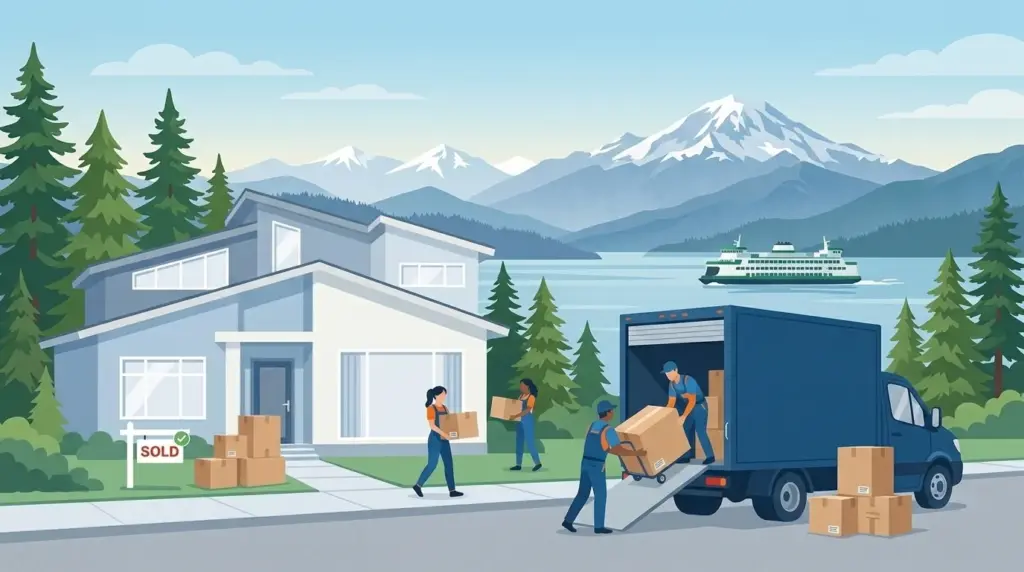
Puget Sound is a four-county regional economy divided by water, ferries, bridges, mountain approaches, and many transit and local-government systems. Seattle, Tacoma, the Eastside, Snohomish County, and Kitsap can look close while requiring completely different daily routes and household-goods handoffs.
This guide uses the Puget Sound Regional Council's King, Kitsap, Pierce, and Snohomish county frame. It compares the central urban corridor, Eastside, north and south growth areas, and ferry-dependent Kitsap choices, then connects housing to transit, water crossings, earthquake and flood review, and final delivery. The aim is to choose a dependable route before treating regional proximity as convenience.
Define Puget Sound before comparing homes
The Puget Sound Regional Council coordinates growth, transportation, and economic planning across King, Kitsap, Pierce, and Snohomish counties. That official four-county frame is the boundary used here.
A regional guide is useful only when it narrows the decision. It should not replace a city guide, county record, school locator, current listing, property inspection, insurance quote, or carrier estimate. Use it to choose the right subarea and jurisdiction; then replace every regional assumption with address-level evidence.
The Moving to Washington guide provides statewide taxes, utilities, road conditions, mover oversight, and arrival context. The official Puget Sound Regional Council defines or coordinates the regional frame used here.
Compare the region by the decision each subarea changes
A list of communities is not enough. Start with the trip, institution, service, or support network that cannot move. Add the property and delivery condition most likely to change the budget. Compare current homes only inside the subareas that survive both tests. A ferry or bridge is part of the address, not a detail added after the lease.
Use the existing Seattle guide, Tacoma guide, Spokane guide for city-level housing, neighborhood, building, parking, and arrival detail. The regional page should connect those guides; it should not repeat them mechanically.
Compare equivalent homes and inspect the property system
Compare current homes within the same county, water-crossing requirement, transit shed, utility arrangement, and hazard context. Add ferry or toll costs, parking, vehicles, insurance, heating, HOA dues, and private systems. A Seattle apartment, Eastside townhouse, Pierce County house, and Kitsap property cannot be compared through one regional price.
Review earthquake and liquefaction information, flood maps, landslide and steep-slope conditions, roof and drainage, moisture and mold, trees, wildfire smoke, snow at elevation, sewer or septic, well water, shoreline exposure, and insurance. A short distance from the urban core can still place the home on a private road or ferry-dependent service pattern.
Test the required route in normal and disrupted conditions
I-5, I-405, I-90, SR 520, the Tacoma Narrows Bridge, Washington State Ferries, Sound Transit, and county transit systems solve different trips. Test the exact station, ferry sailing, transfer, parking, and last return. Run a missed-ferry or bridge-disruption scenario and confirm whether the household can tolerate it repeatedly.
Run the route at the hour it must occur, not at a convenient research time. Record the normal trip, the credible disruption, parking or toll cost, transit transfer, first and last mile, and the last practical return. Recheck the responsible transportation agency, including ORCA regional fare system, before signing and again before moving day.
Make the written estimate name the entire regional handoff
Give the mover the county and municipality, ferry terminal and sailing plan if needed, bridge or toll route, legal curb, hill, driveway, gate, branches, wires, stairs, elevator, dock, and turn radius. Confirm whether the carrier will place a truck on the ferry, transload locally, use separate crews, or store the shipment—and identify who carries responsibility at each handoff.
Give every provider the same room-by-room inventory, dates, origin, destination, access photographs, packing request, heavy-item list, and required services. For an interstate move, verify the company and expected carrier through FMCSA Protect Your Move. For a move entirely within Washington, use the state mover resource cited below and obtain the legal business name, written price terms, payment and cancellation rules, insurance information, and damage process.
Match education, work, and services to the chosen jurisdiction
Technology, aerospace, ports, military installations, universities, health systems, logistics, and public employment are distributed across the four counties. Verify school assignment, employer site, shift, ferry or transit timing, and child-care or health-care access. The University of Washington and other campuses create routes that differ from downtown employment.
Confirm the public-school assignment with the responsible district, not a listing or neighborhood name. Check child care, health care, groceries, public safety, libraries, parks, higher education, and utilities from the actual home. A service inside the region may still be impractical when it requires the wrong bridge, freeway direction, ferry, county line, or winter route.
Carry one verified address record from search through delivery
The same address record should drive the listing comparison, route test, property review, school and utility checks, quote, permit or building reservation, insurance, delivery instructions, and state arrival tasks. Changing one description without updating the others creates the same problem as comparing different homes.
Puget Sound moving questions
Should I use a regional average to set my housing budget?
No. Use equivalent current listings in the same jurisdiction, housing type, route, and property context. Add the recurring costs and access conditions attached to those exact homes.
Can a city guide replace this area guide?
No. Use the area guide to choose the correct subarea and regional route. Use the city guide for neighborhood, building, parking, and municipal detail after the destination narrows.
Can a mover quote the job from the area name?
No reliable complete quote can be based only on a regional name. The provider needs both addresses, inventory, services, access conditions, dates, and every special handoff.
What should I recheck immediately before the move?
Road, bridge, tunnel, ferry, transit and weather conditions; permits or building reservations; carrier status; access contacts; utilities; and the agreed delivery instructions.
Browse the city and regional moving-guide directory, return to the Washington state guide, check the moving-route directory, or use the Moveline calculator for an early route-and-home-size estimate before collecting written quotes.
Sources
Regional definitions, transportation, hazard, mover, and arrival sources were checked August 4, 2026. Follow the live official page for current boundaries, alerts, schedules, maps, forms, and rules.
- Puget Sound Regional Council
- Washington State Ferries
- ORCA regional fare system
- Sound Transit
- King County Metro
- Pierce Transit
- King County flood services
- University of Washington
- WSDOT real-time map
- Washington DOL moving guidance
- Washington UTC household-goods carriers
- Washington Emergency Management Division
- FEMA Flood Map Service Center
- FMCSA Protect Your Move