

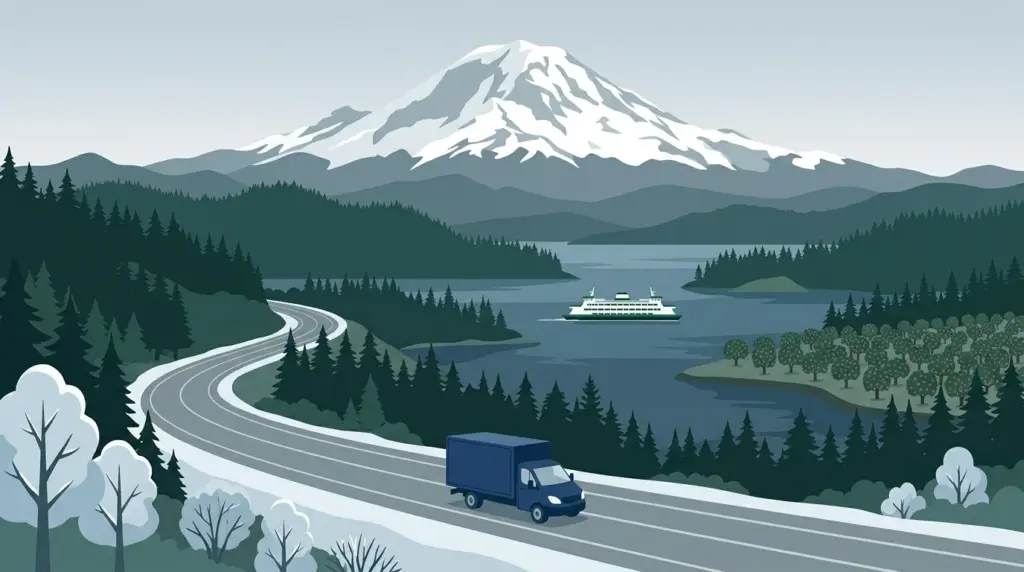
Why Washington State begins on one side of the Cascades
Washington State offers very different daily lives around Puget Sound and east of the Cascades. Seattle and Tacoma share a western regional system of ferries, bridges, and dense urban access, while Spokane is an inland market with a separate housing and travel pattern. The state can fit both kinds of move, but not with one set of assumptions.
Washington’s broad 2024 price level was 7% above the U.S. average, and the statewide median home sale price was $651,800 in May 2026. Residential electricity rates were below the national rate, which can help the operating budget, but housing remains the larger commitment. Insurance, transportation, and the home’s exact utility use still need to be priced locally.
Compare Seattle, Tacoma, and Spokane from current homes inside a realistic daily radius. In western Washington, include bridge, ferry, parking, and dense-building access where relevant; inland, price winter travel and service distance. The best Washington choice begins with the side of the mountains where life will happen.
State hierarchy: Moving Guides by State · Houston-to-Seattle Moving Guide: Route, Access, Quotes, and Timing · San Francisco to Seattle Moving Cost (2026 Guide) · Seattle-to-Phoenix Moving Cost: Rental Truck vs. Full Service.
Where should you live in Washington State?
Washington divides sharply across the Cascades. Puget Sound cities share ferries, bridges, dense employment, and high housing costs; Spokane and the Inland Northwest have a separate climate and regional economy. The coast, Olympic Peninsula, Columbia Basin, and rural mountain communities add further choices.
The historical rent range runs from $1,215 in Spokane to $2,030 in Seattle, a $815 monthly spread. That is large enough to change the shortlist, yet it still cannot price the same bedroom count, neighborhood, condition, commute, or insurance at a live address.
Smaller communities and rural Washington State: Olympic Peninsula and coastal towns, Cascade communities, island homes, Columbia Basin agriculture, and eastern forest or wheat country require separate plans. Confirm ferry or pass dependence, wildfire and smoke, flood and coastal wind exposure, well and septic systems, broadband, health care, private-road maintenance, snow, and mover access. Island delivery may need a smaller truck or ferry reservation.
Build the complete cost of moving to Washington State
Moving Cost by State provides a national comparison frame. Transportation for a Washington State move is driven by inventory or shipment weight, exact addresses, access, mileage, dates, service level, packing, valuation choice, storage and delivery terms. Housing and settlement costs are separate. A low transportation estimate does not make the relocation affordable if it omits travel, overlap, deposits, utilities or registration.
Statewide screening currently combines a 107.0 regional price-parity index with a $651,800 median sale-price observation. Keep those benchmarks in separate columns because one describes broad price levels and the other describes completed home sales. The latest stored combined state-and-average-local sales-tax rate is 9.429%. It is a general comparison measure, not the tax treatment of a particular purchase or household.
For a Washington State move, seasonality affects availability and exposure rather than applying one universal markup. Summer demand, weekends and month-end dates can tighten capacity; winter conditions, heat, storms, wildfire smoke or hurricane exposure vary by state and route. Compare the same scope across at least two feasible date windows.
Control arrival tasks and deadlines in Washington State
Washington State new-resident deadlines need a current official check because the trigger may be residency, employment, vehicle use or another event—not simply the truck’s arrival date. The checklist sends time-sensitive registration and deposit questions to the controlling official source instead of presenting statewide planning benchmarks as legal deadlines.
At the selected Washington State address, reserve building or curb access before dispatch. Confirm elevator hours, loading space, certificates, container restrictions, gate or HOA rules, parking permits and the person authorized to accept delivery. Keep identification, medicines, keys, chargers, records and first-night supplies outside the shipment.
NOAA’s cited state count includes 2 billion-dollar events for 2024-12-31. Use that Washington State count only as a prompt for address-level hazard, insurance and route checks; it does not measure the probability or severity at a home.
A Washington plan may need ferry reservations, mountain-pass checks, rain protection, wildfire-smoke contingencies or snow flexibility depending on the address and origin. Confirm whether a quoted route assumes a ferry, toll facility or pass that can change with vehicle size and weather.
Turn the Washington State research into a controlled project
Build one Washington State decision sheet with the chosen address, rejected alternatives, inventory, access facts, date windows, quote assumptions, travel plan, arrival cash, responsible person and evidence link for every changing rule. Label each field confirmed, estimated, not applicable or unresolved.
The plan is ready when the household can explain why the selected Washington State market works, what the move includes, how the origin changes execution, which deadlines apply, how much cash is required before and after delivery and what happens if housing or timing changes.
Sources
- U.S. Bureau of Economic Analysis Regional Price Parities
- U.S. Census Bureau 2020–2024 American Community Survey 5-Year Data
- U.S. Census Bureau Vintage 2025 City and Town Population Estimates
- U.S. Census Bureau State Population Estimates
- FMCSA: Estimating Charges
- FMCSA: Plan Your Move
- NOAA Billion-Dollar Weather and Climate Disasters
- Redfin Data Center
- USA.gov State Motor Vehicle Services Directory
- U.S. Census Bureau: Gross rent definition
- U.S. Census Bureau: Median real estate taxes
- NCES College Navigator
- National Park Service: Washington State
- State of Washington Tourism