

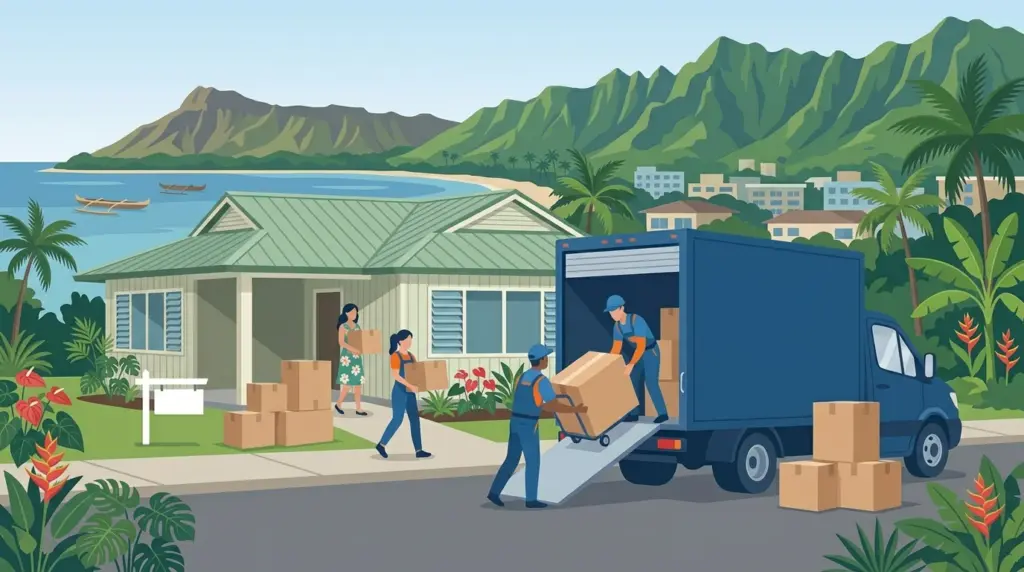
A move to Oʻahu is not finished when the container reaches Honolulu Harbor. The destination may be a high-rise with a reserved elevator, a Leeward subdivision reached through daily traffic, a Windward home exposed to heavier rain, or a North Shore property where the final truck has limited places to turn. Household goods, a vehicle, pets, and the people moving can also arrive on different days.
This guide helps you choose the part of Oʻahu that fits your daily life, price every segment from the mainland home to the final room, and prepare the exact address for delivery. It covers Honolulu, Central and Leeward Oʻahu, the Windward side, and the North Shore; the separate Honolulu guide goes deeper on city neighborhoods and apartment-building access.
Choose the Oʻahu area before requesting a complete price
The useful first decision is not simply “Oʻahu.” It is which daily corridor and which kind of property you are moving into. A lower housing price can be erased by two long commutes, paid parking, a second car, or a difficult delivery. Map work, school, care, groceries, and recurring family trips from the actual address, then inspect the route from the legal truck position to every room.
| Area | What changes for the household and delivery |
|---|---|
| Honolulu and East Honolulu | Dense housing, paid or assigned parking, loading rules, elevators, and limited curb space make the exact building more important than mileage. Use the Honolulu guide for city detail. |
| Central and Leeward Oʻahu | Pearl City, ʻAiea, Waipahu, Kapolei, ʻEwa, and the Waiʻanae Coast create different work and school trips. Test H-1 traffic, parking, heat exposure, and whether the property can accept a large delivery vehicle. |
| Windward Oʻahu | Kailua, Kāneʻohe, and smaller communities across the Koʻolau range can mean wetter conditions and a commute through a limited set of cross-island corridors. Check drainage, wind, covered unloading space, and the real peak-hour trip. |
| North Shore | Haleʻiwa and communities along the northern coast trade urban proximity for a longer service and work trip. Inspect road width, bridge and driveway clearance, visitor traffic, flood exposure, and access for the mover assigned to final delivery. |
Oʻahu has more urban services and moving capacity than the neighbor islands, but that does not make every delivery simple. Ask a property manager, landlord, or seller for written loading instructions, elevator dimensions, allowed hours, insurance requirements, parking rules, gate access, stair count, and the point where a container truck would have to transfer the shipment to a smaller vehicle.
Price the move as connected segments
There is no honest Oʻahu-wide average that covers a mainland pickup, ocean transportation, port release, and inside delivery. Ask each company to price the same inventory and the same destination access, then show what is included in each segment. The Moveline calculator can help with an early mainland household-move comparison, but it is not an ocean-freight quote.
| Price segment | What to confirm in writing |
|---|---|
| Mainland home to port | Packing, materials, loading, the container or lift van, trucking, origin terminal charges, and any storage before sailing. |
| Ocean movement | The water carrier, sailing or service window, tariff or contract charges, destination port, protection, and the event that counts as cargo availability. |
| Honolulu release | Who receives the notice, pays port-related charges, handles an inspection or hold, collects the equipment, and tracks the deadline for returning it. |
| Final Oʻahu delivery | Local truck, smaller transfer vehicle if needed, labor, stairs, elevator or loading reservations, carrying distance, assembly, debris removal, waiting, and empty-equipment return. |
If one provider gives a single total, ask it to name every company that will touch the shipment and the exact address where responsibility changes. For an interstate highway segment, verify the carrier or broker through FMCSA Protect Your Move. For local household-goods work on Oʻahu, check the company through the Hawaiʻi Public Utilities Commission.
Test transportation, education, and services from the address
TheBus reaches communities across Oʻahu, while Skyline and connecting bus routes can change the value of some Central and Leeward addresses. The city modified routes when Skyline’s second segment opened in October 2025, so an older commute description may already be wrong. Test the complete trip on the current schedule: walk, wait, transfer, last service home, and the trip with children or groceries.
Education options are distributed across the island. The University of Hawaiʻi system lists UH Mānoa, UH West Oʻahu, Honolulu Community College, Kapiʻolani Community College, Leeward Community College, and Windward Community College on Oʻahu. A campus name that looks nearby on a regional map can still require a difficult cross-island trip. For K–12 enrollment, verify the public-school assignment and any geographic exception with the Hawaiʻi Department of Education rather than a listing agent.
Also test the repeated healthcare, military, airport, and family trips at the hour they will occur. A home near one corridor can be a poor fit for a household whose days repeatedly cross the island. If the routine requires two cars, add shipping or replacement, registration, insurance, fuel, maintenance, and parking before deciding that the home is affordable.
Route pets and agricultural items separately
Dogs and cats entering through Daniel K. Inouye International Airport follow Hawaiʻi’s animal-quarantine pathway. Direct airport release is not automatic: vaccination history, a passing FAVN test, state forms, health documentation, payment, arrival timing, and inspection requirements must all fit the current checklist. Start with the state checklist and the veterinarian before buying a nonrefundable flight; airline acceptance is a separate decision.
Hawaiʻi also requires agricultural declarations and inspection for regulated material. Give the mover a separate list of plants, soil, seeds, produce, firewood, outdoor equipment, and animal-related materials before packing. Clean outdoor items, but do not treat cleaning as a substitute for declaration or a required permit. Keep pet and agriculture documents with the traveler, not inside the ocean shipment.
Prepare the Oʻahu address before cargo becomes available
Confirm utilities, keys, gate codes, lawful truck position, elevator or loading reservation, and the person authorized to accept delivery. City Satellite City Halls handle many vehicle-registration and titling transactions at locations around Oʻahu, but services and appointment rules differ. Use the current office page instead of assuming the nearest site can complete an initial out-of-state registration.
The broader Moving to Hawaii guide explains the mainland-to-state sequence for ocean freight, cars, pets, agriculture, and island delivery. Use this page for the Oʻahu decision and the state guide for the full shipment chain.
Sources
Official rules and time-sensitive information were reviewed August 3, 2026. Follow the live agency or provider page for current schedules, forms, fees, and alerts.
- Hawaiʻi DOT Harbors: statewide commercial harbor system and harbor contacts
- Honolulu DTS: TheBus changes connected with Skyline expansion and Skyline stations and parking
- City and County of Honolulu: Satellite City Halls
- Hawaiʻi Department of Agriculture and Biosecurity: animal quarantine and airport release
- Hawaiʻi Plant Quarantine Branch: import program
- University of Hawaiʻi: campuses