

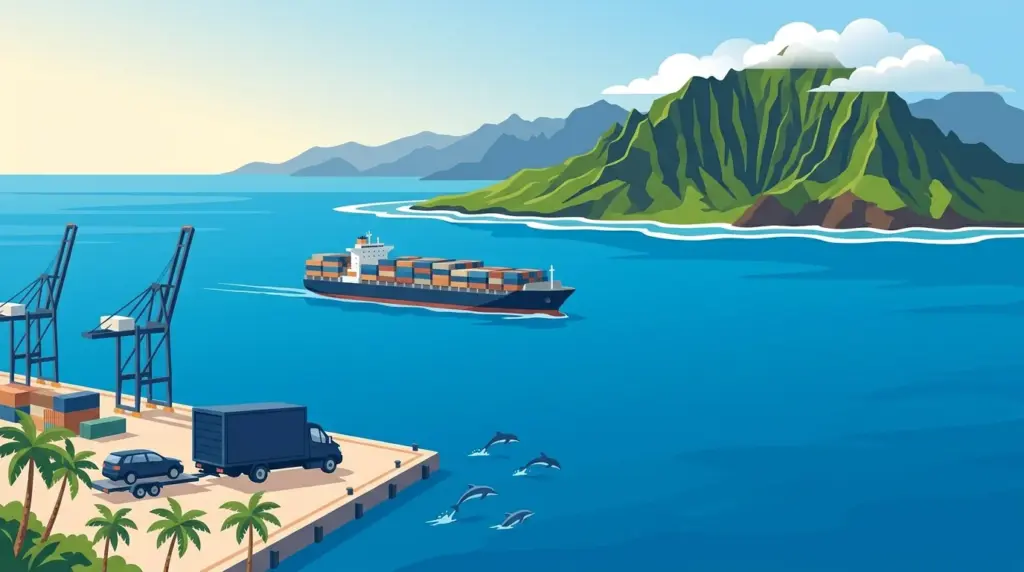
A mainland-to-Hawaii move is not one long truck trip. Your furniture may enter a sealed container and wait in a port yard, your car travels under a separate booking and must be collected during terminal hours, and your dog can be sent to quarantine or back out of state if the animal-entry work is incomplete. Choosing the wrong island or arrival port can add another ocean or barge handoff after the shipment already crossed the Pacific.
This guide follows the move in the order the decisions must be made: island and address, household shipment, pets, agricultural inspection, car, destination port, local delivery, and county registration. It explains which provider controls each handoff, what the written quote must include, and why arrival at the harbor is the start of a timed release process rather than the end of the move.
EIA’s May 2026 residential rate was 182% above the U.S. residential rate. Honolulu’s cited median gross rent was $1,823 per month. Use current listings for the same home size and lease terms before treating that historical figure as a current budget.
Choose the island and destination address before requesting quotes
The address decides the discharge port, whether an interisland transfer is needed, how far a local truck must travel, and which county registers the car. Ask every provider to name the mainland origin terminal, Hawaii discharge port, any Honolulu transfer, destination trucking company, and final service included. “To Hawaii” is not a complete service description.
| Island guide | Areas covered and what changes |
|---|---|
| Oʻahu | Areas covered: Honolulu, Central and Leeward Oʻahu, Windward Oʻahu, and the North Shore. Honolulu Harbor is the main cargo hub, but the final delivery changes with high-rise loading rules, H-1 traffic, cross-island corridors, and the exact property access. |
| Maui | Areas covered: Kahului and Wailuku, Kīhei, West Maui, Upcountry, and Hāna. Kahului is the commercial port; the destination road, distance, building, and available local equipment determine the last segment. Direct pet arrival at Kahului requires the separate Neighbor Island Inspection Permit pathway. |
| Hawaiʻi Island | Areas covered: Hilo, Kona, Waimea and Kohala, Puna and Volcano, and Kaʻū. Hilo and Kawaihae serve different sides of the island. The full address should drive the port, route, local truck, property-access check, and county registration plan. |
| Kauaʻi | Areas covered: Līhuʻe and Nāwiliwili, Kapaʻa and Wailua, the North Shore, South Shore, and West Side. Cargo enters through Nāwiliwili, while road resilience, distance, property rules, and local capacity shape delivery. Direct pet arrival at Līhuʻe uses the Neighbor Island permit and approved-inspector process. |
| Molokaʻi and Lānaʻi | Areas covered: Kaunakakai and Molokaʻi’s east and west ends, plus Lānaʻi City and other Lānaʻi properties. Kaunakakai and Kaumalapau have limited sailing and gate schedules. Confirm the interisland booking, local crew, equipment, road access, cargo pickup, and return plan before mainland pickup. |
Young Brothers moves freight among Honolulu, Nawiliwili, Kahului, Kaunakakai, Kaumalapau, Hilo, and Kawaihae, but it does not ship to the mainland. Its published gate hours vary sharply by port, and neighbor-island cargo may transship through Honolulu. If a quote uses interisland service, ask who makes that booking, who pays and tracks it, and who collects the cargo at the final island.
Separate the move into four controlled streams
Make one master list, then mark each item as household freight, accompanied baggage, car, pet, or regulated agricultural material. The same object cannot be assumed to travel in any available space. Most vehicle programs prohibit personal belongings in the car, some batteries and fuels are restricted, and plants or soil may require inspection or a permit.
Keep essential medication, identification, pet records, leases, keys, work equipment, chargers, and enough clothing in accompanied baggage. An ocean schedule is not a guaranteed household delivery date. Vessel changes, weather, port availability, inspection, interisland transfer, truck scheduling, and building access can all separate you from the container.
Finish the pet pathway before buying the flight
Hawaii is rabies-free and does not treat an arriving dog or cat like ordinary checked baggage. The Department of Agriculture’s current program requires a sequence of rabies vaccinations, an approved FAVN rabies antibody test, waiting periods, the Dog and Cat Import Form, health documentation, payment, and arrival inspection. Missing a requirement can mean quarantine, delayed release, transport to Honolulu, or removal from the state at the owner’s expense.
For Honolulu, follow the official Direct Airport Release and 5 Day Or Less checklist. The state says documents must be received at least 10 days before arrival to qualify for the lower-cost direct-release review, though veterinary work and the FAVN waiting period must start much earlier. Current Honolulu inspection hours also make late-day flights risky: a pet that reaches the holding facility after the release window may stay overnight.
Direct arrival at Kona, Kahului, or Lihue is a different pathway. A Neighbor Island Inspection Permit is required before boarding, along with advance paperwork and a reservation with an approved private veterinary inspector. The state says the required permit documents should arrive 30 days or more before the planned flight. No equivalent direct-arrival program is listed for every airport, so confirm the actual island route before purchasing a nonrefundable ticket.
Ask the airline about breed, size, crate, temperature, aircraft, seasonal, and routing rules separately. Hawaii approval does not require an airline to accept the pet. Arrange a vehicle that can hold the intact crate at release; the state says owners are responsible for moving the crated animal from the holding facility and cannot open the crate on airport property. For birds, rabbits, reptiles, livestock, or other animals, use the Plant Quarantine animal guidelines rather than the dog-and-cat checklist.
Declare agricultural items before they become a port problem
Hawaii’s Plant Quarantine Branch says all agricultural items entering from the mainland require inspection. That category includes plants and plant parts, soil, certain animals, insects, microorganisms, and related material. Some items require permits before import, and some are prohibited. Travelers must declare agricultural items on arrival; transportation companies must notify inspectors and keep regulated cargo available until inspection is complete.
Do not hide a houseplant in a sealed box or assume washed patio furniture is irrelevant. Give the mover a written list of plants, wreaths, seeds, produce, soil, firewood, outdoor equipment, and animal-related materials before packing. Ask whether the provider accepts the item, what HDOA document or inspection is required, and who opens or holds the container if an inspector needs access.
Clean lawn tools, bicycles, camping equipment, grills, and outdoor furniture so they are free of soil, seeds, insects, and plant debris. Cleaning does not replace declaration or a permit. If the item has little value or uncertain eligibility, selling or discarding it on the mainland can be safer than risking delay or disposal in Hawaii.
Quote the household shipment from door to door, line by line
A full-container quote can include very different work. One company may pack at the home, arrange mainland trucking, book ocean space, manage the Hawaii port, and deliver inside. Another may quote only port-to-port transportation. Require each proposal to show who performs every segment and where responsibility changes.
| Quote line | Question to resolve before payment |
|---|---|
| Mainland origin | Who packs, loads, provides the container, hauls it to the port, and pays terminal or rail charges? Is the price based on weight, volume, container, or specific services? |
| Ocean movement | Which water carrier, sailing, origin port, discharge port, and bill of lading apply? Are fuel adjustments, wharfage, security, invasive-species, and other tariff charges included or passed through? |
| Neighbor-island transfer | Does the ocean carrier call the destination port directly, or will cargo move through Honolulu and another barge? Who books, tracks, pays, and handles that transfer? |
| Hawaii release | Who receives the availability notice, clears any inspection or hold, pays charges, and has authority to collect the container from the terminal? |
| Final delivery | Which local company picks up, unloads, carries items inside, assembles furniture, returns the empty container, and handles a building or road the container truck cannot reach? |
| Delay and damage | When do storage or container-detention charges start, what event triggers them, who pays after a missed delivery, and what protection covers ordinary damage rather than only a total vessel loss? |
The Surface Transportation Board regulates water carriers in the noncontiguous domestic trade between the contiguous states and Hawaii. It requires those carriers to maintain public tariffs containing rates, charges, rules, and service terms. The STB’s current certification list includes Matson and Pasha Hawaii. Ask for the tariff or contract terms that govern the actual shipment rather than relying on a sales summary.
If a motor carrier handles the interstate highway portion, verify its U.S. DOT record through FMCSA Protect Your Move. Ask which company is responsible for the through move and whether separate motor and water documents apply. Keep the item list, condition photos, estimate, service order, bills of lading, receipts, container number, seal number, and contact information together.
Matson’s current personal-household-goods instructions illustrate why the destination trucker must be ready. After a westbound container becomes available in Hawaii, the company allows 10 calendar days to collect it, unload it, and return it empty before storage or detention charges apply. That is a provider term, not a statewide universal rule. Obtain the exact free time and daily charges from the company named in your booking.
Pack for an ocean handoff, not only a truck ride
Ocean freight can experience vibration, salt air, heat, humidity, container movement, and several loading events. Ask who braces and secures the load, whether the container remains sealed through the route, and what packing standard the contract requires. Use a numbered item list and label every carton by room and number so the delivery count is possible even when several crews touch the goods.
Do not pack propane cylinders, gasoline, ammunition, fireworks, paint, aerosols, cleaning chemicals, lithium batteries, or other hazardous material until the provider has given written acceptance and preparation instructions. “The mover took it last time” is not approval for an ocean shipment. Separate irreplaceable documents, jewelry, cash, medication, and digital backups from the container.
Review marine and household-goods protection carefully. Carrier liability, released-value protection, homeowner coverage, renter coverage, and a marine policy are not interchangeable. Ask what events and items are excluded, whether mold or water damage is covered, how pairs and sets are valued, how notice must be given, and what deadline applies to a claim. Do not describe protection as “full” unless the written terms actually provide it.
Ship the car as a separate project
First compare shipping with selling and replacing. Consider the ocean price, mainland delivery to the terminal, transportation while the car is in transit, port pickup, Hawaii insurance, safety inspection, registration, annual weight-based fees, and whether the vehicle fits island roads and parking. A large truck can be useful on a rural property and awkward in an Oahu garage.
Carrier rules are vehicle-specific and can change. Matson currently requires an operating vehicle, working emergency brake, acceptable warning-light and damage condition, minimum ground clearance, and fuel between one-eighth and one-quarter tank. It prohibits personal belongings in cars moving to Hawaii and currently suspends acceptance of electric and plug-in hybrid vehicles. Pasha also requires advance appointments and says vehicles are not available on the day the vessel arrives.
Wait for the availability notice before going to the Hawaii terminal. Matson says pickup requires the booking number and photo identification, with advance written authorization if someone else collects the car. Its published hours vary by port, and Hilo, Nawiliwili, and Kahului vehicle lots operate on selected days. Pasha also requires a representative to schedule pickup. Coordinate ground transportation and do not assume the car will be released when the vessel docks.
Register the vehicle through the destination county
Hawaii vehicle registration is administered by county, so the same generic checklist should not be used on every island. The recurring sequence is Hawaii auto insurance, an official safety inspection, the county transaction, and a return to the inspection station when the initial certificate failed only because registration had not yet been converted. Keep the shipping receipt or bill of lading and follow the destination county’s current document list.
| County | Current official starting point |
|---|---|
| Honolulu / Oahu | The City and County of Honolulu explains the inspection-first process, shipping documents, out-of-state permit or Hawaii plates, and the return inspection. Initial registration and out-of-state transactions may require an AlohaQ appointment. |
| Maui County | Maui’s out-of-state page lists the application, registration and title or lien documents, temporary safety inspection, bill of lading, possible tax form, and weight documentation. |
| Hawaii County | Hawaii County requires the out-of-state registration, title when applicable, bill of lading or shipping receipt, Hawaii safety inspection, and other documents based on model year and vehicle record. |
| Kauai County | Kauai says an out-of-state vehicle requires the appropriate appointment and provides a county checklist for the title, registration, application, failed safety check, and related documents. |
Matson’s current Hawaii pickup page tells customers to register within 30 calendar days after collecting the car. Use the county rule and deadline that apply to your situation, including any out-of-state permit option. A military service member may have different residency and weight-tax documents; use the county’s military instructions rather than a civilian summary.
Use a sequence that keeps every release possible
Several months before
Choose the island and address, start the pet’s veterinary sequence, decide whether the car goes, identify regulated agricultural items, and obtain comparable door-to-door proposals.
Before signing contracts
Name every company and port, identify all included charges, read the tariff and protection terms, verify destination access, and reserve any building elevator or loading dock.
Before loading
Finish pet paperwork, confirm airline acceptance, remove prohibited goods, clean outdoor items and the car, photograph condition, and keep essential records out of the container.
While cargo is at sea
Confirm utility and building readiness, local trucking, pet pickup, car pickup authorization, terminal contacts, and transportation until the car is available.
When availability notices arrive
Release the household container and vehicle through their separate terminals, complete inspection or hold requirements, count and inspect goods, return equipment on time, and begin county registration.
Do not use Moveline’s contiguous-state road calculator as an ocean-freight quote. A Hawaii move needs written prices from providers that name the water movement, ports, destination trucking, and local access. The successful move is the one in which the pet qualifies before the flight, the container has a truck before free time expires, and the car’s county documents are ready before pickup.
Official and carrier sources
Requirements and service information were reviewed August 3, 2026. Recheck the live page for forms, fees, terminal dates, and deadlines.
- Hawaii Department of Agriculture: animal quarantine and direct-release requirements
- Hawaii Department of Agriculture Plant Quarantine: mainland import inspection and declaration and travel and shipping information
- Hawaii DOT Harbors: commercial harbor contacts
- Surface Transportation Board: noncontiguous domestic water-carrier jurisdiction and current tariff certifications
- Matson: personal household-goods container process, vehicle preparation, and Hawaii vehicle pickup
- Pasha Hawaii: vehicle appointment, preparation, and release questions
- Young Brothers: interisland services, port contacts and gate hours, and shipping questions
- County vehicle registration: Honolulu out-of-state vehicle inspection sequence, Maui, Hawaii County, and Kauai
- FMCSA Protect Your Move