

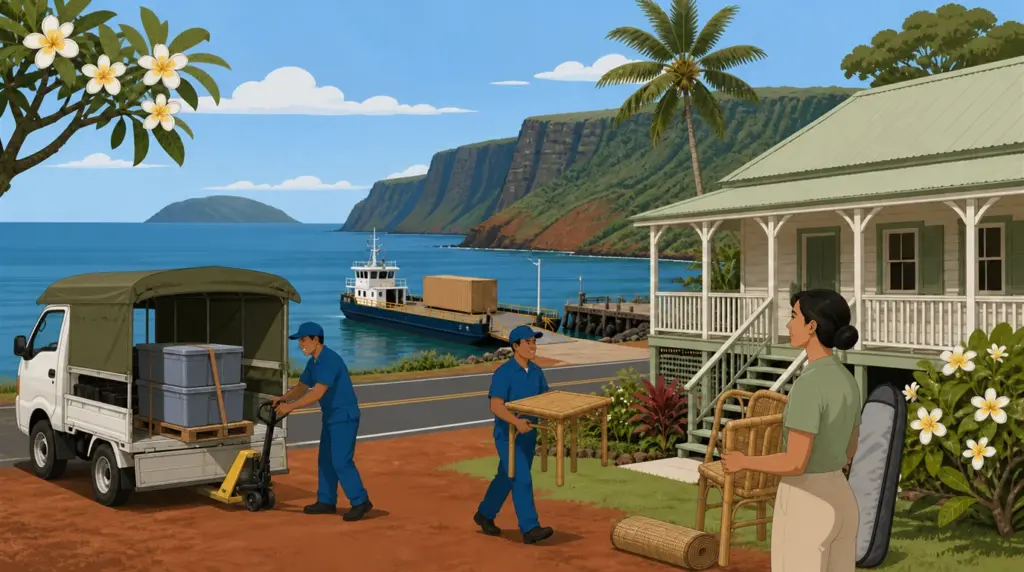
Molokaʻi and Lānaʻi share a county, but they are not one delivery market. Molokaʻi cargo enters at Kaunakakai and homes stretch far beyond the town; Lānaʻi cargo enters at Kaumalapau and then climbs to Lānaʻi City or continues toward a more remote property. Limited sailings, gate hours, local equipment, and backup labor make timing less flexible than on Oʻahu or Maui.
This guide compares Kaunakakai and the east and west ends of Molokaʻi with Lānaʻi City and the rest of Lānaʻi. It shows how to secure the barge, local carrier, pet route, vehicle paperwork, daily services, and final access before mainland pickup begins.
Treat Molokaʻi and Lānaʻi as separate delivery plans
The first booking decision is which island, port, local carrier, and street address will complete the move. A proposal that says only “Maui County” or “neighbor island” is incomplete. Ask the provider to name Kaunakakai or Kaumalapau, the planned sailing, cargo type, person collecting it, final truck, inside-delivery scope, and empty-equipment return.
| Destination | What changes for the move and daily life |
|---|---|
| Kaunakakai and central Molokaʻi | Closest to Kaunakakai Harbor, county offices, and a concentration of services. Confirm the legal cargo pickup, truck position, property access, and whether the mover performs inside delivery or only port collection. |
| East and west Molokaʻi | A longer road trip and fewer alternate routes make weather, bridge or road conditions, local equipment, crew time, fuel, and a safe turnaround more important. Verify the exact driveway and service availability. |
| Lānaʻi City | Most homes and core services are uphill from Kaumalapau Harbor. Confirm the harbor-to-city carrier, vehicle availability, road and driveway access, unloading position, and the plan if a sailing shifts. |
| Other Lānaʻi properties | Do not assume a road shown on a map is suitable for a moving truck. Private, unpaved, restricted, or rough access may require permission, smaller equipment, or a different delivery arrangement. |
Secure the interisland barge and local crew as one chain
Hawaiʻi DOT operates commercial harbors at Kaunakakai and Kaumalapau. Young Brothers serves both ports and publishes port contacts, gate information, sailing changes, and cargo-availability notices. Its June 2026 notices showed how weather and ocean conditions could prevent discharge or berthing and require a recovery sailing. Use that as a planning lesson, not a schedule prediction.
There is no useful two-island average price. Ask for separate written amounts for mainland packing, mainland transport to port, ocean service to Hawaiʻi, any Honolulu transfer, interisland barge, destination port charges, local pickup, smaller equipment, inside delivery, storage, vehicle shipment, and equipment return. Identify which company pays and tracks each part.
Confirm how much notice the local crew needs and what happens when the barge changes days. Ask when storage or equipment charges begin, whether the consignee must be present, what identification or port credentials are required, and which cargo types have different availability times. Do not schedule a flight or a mainland lease end around an estimated barge arrival alone.
Verify the home’s access and essential services before shipping
For either island, verify electricity, water, wastewater, internet, refuse service, road ownership, physical addressing, emergency access, and the party maintaining the driveway. Ask for current photographs or a live video walk from the public road to every room. Measure the gate, tight turns, overhead clearance, steps, and space for a safe turnaround.
Daily transportation deserves a written plan. Maui County says its MEO Human Services Transportation program supports specialized trips on Molokaʻi and Lānaʻi, including eligible dialysis, disability, senior, youth, and group transportation. That is not the same as a frequent public bus for every rider. Confirm eligibility, reservation requirements, schedule, and the household’s ordinary work, school, grocery, medical, and airport trips before deciding whether to ship a vehicle.
UH Maui College has education centers serving Molokaʻi and Lānaʻi, while K–12 students use state schools. Verify programs and school placement directly. Healthcare, pharmacies, repairs, building materials, childcare, and specialty services can require limited local availability or off-island travel. A home decision should include those repeated needs, not just the shipment.
Plan vehicles and pets around island-specific limits
Maui County maintains DMV offices in Kaunakakai and Lānaʻi City, but hours and services differ. Follow the county’s out-of-state registration instructions and call the relevant office before going. For a shipped vehicle, ask who books the interisland segment, which port releases it, who may collect it, what condition record is created, and how the household travels before it becomes available.
Molokaʻi and Lānaʻi are not among the state’s direct Neighbor Island Inspection Permit airports. The approved direct airports are Kona, Kahului, and Līhuʻe. A dog or cat moving to Molokaʻi or Lānaʻi therefore needs an approved entry and onward-travel plan—commonly clearance through Honolulu—coordinated with the Animal Quarantine Station, veterinarian, and airline before tickets are purchased.
Do not assume an interisland connection can carry the pet immediately after state release. Confirm airline acceptance, crate, aircraft, timing, ground transfer, and any overnight needs. Plants, soil, produce, seeds, outdoor equipment, and other regulated agricultural material also require declaration and may need inspection or a permit. Keep all approvals with the traveler.
Build enough flexibility for a missed handoff
Carry medication, documents, work and school equipment, pet supplies, chargers, clothing, and basic bedding. Arrange a local contact who can receive an availability notice, inspect the home, open a gate, or meet the carrier if the household’s flight changes. Keep enough time in the origin housing and destination setup for a sailing or delivery shift.
Count the numbered inventory at delivery and note loss or damage on the delivery record. Keep every estimate, bill of lading, barge document, container or equipment number, condition photo, receipt, and written schedule. The Moving to Hawaii guide explains the full mainland-to-state shipment; this page covers the extra interisland and local-service decisions.
Sources
Official rules and time-sensitive information were reviewed August 3, 2026. Follow the live agency or provider page for current schedules, forms, fees, and alerts.
- Hawaiʻi DOT Harbors: commercial harbor system and Kaunakakai and Kaumalapau contacts
- Young Brothers: port contacts and gate information, cargo availability, and interisland services
- Maui County: MEO Human Services Transportation for Molokaʻi and Lānaʻi
- Maui County: Molokaʻi and Lānaʻi DMV locations and hours and out-of-state registration
- Hawaiʻi Department of Agriculture and Biosecurity: animal quarantine and approved neighbor-island airports
- Hawaiʻi Plant Quarantine Branch: import program
- University of Hawaiʻi: Maui College and education centers