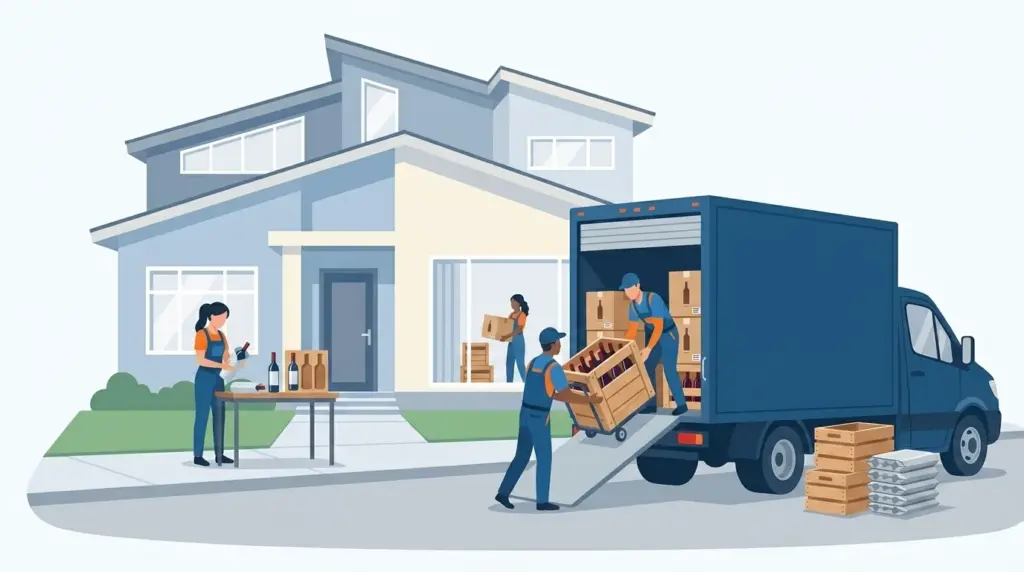
Moving a Wine Collection: Temperature, State Rules, Packing, and Insurance
Choose custody, verify current state permits and quantity rules, protect the established temperature, and document the collection from cellar to cellar.
By Matt
July 31, 2026 •
1 min read
A wine collection requires more control than ordinary household goods because bottles can lose condition or financial value without breaking. Heat while cases wait, a mover that has not agreed to carry alcohol, state rules along the route, incomplete ownership records, and an undocumented handoff can leave the owner with compromised wine and too little evidence for a claim.
This guide gives you one cellar-to-cellar plan. Choose who will keep custody before selecting cartons or booking a truck. Then build the bottle and value records, verify the route and each provider’s acceptance, control temperature, pack and document every case, choose protection, and reconcile delivery against the same list.
Build one inventory for custody and another for value
The working inventory should identify producer, wine, vintage, format, quantity, rack or case location, and the carton ID used during the move. Add clear photographs of important labels, fill levels, capsules, closures, original wood cases, and any existing seepage or damage. This is the list the packing lead and receiver use to count the collection without opening every carton on a loading dock.
Keep a separate valuation file with acquisition records, provenance, appraisals, current value support, and insurer correspondence. The crew does not need a price printed on every carton, but the carrier and insurer need an accurate description and any required declaration of high-value property. Chubb’s collector guidance likewise recommends a current appraisal, a complete inventory, and owner presence at loading and delivery.
Bottle count alone is a poor risk measure. Twenty-four everyday bottles are a different job from 24 mature bottles that cannot be replaced in the same condition. Ask a qualified appraiser, merchant, auction specialist, or insurer to update values when receipts no longer describe the collection.
Control the hours outside the cellar
Wine continues to change in the bottle, and warmer storage accelerates that change. A two-year Malbec study comparing 59 degrees F and 77 degrees F found faster chemical and sensory development at the warmer condition. Research on white wine also found that storage temperature affected browning and aroma evolution. Transport research has measured significant heat exposure in commercial U.S. wine shipments.
Those studies do not create a universal damage clock. A bottle’s wine style, closure, starting temperature, prior storage, packaging, exposure length, and number of warm-cool cycles all matter. For a move, the useful target is simple: stay close to the collection’s established cool temperature and minimize every uncontrolled wait.
Pack so condition can be preserved and proven
Use sturdy wine-shipping cases with fitted cells or molded inserts that prevent bottle-to-bottle contact. Large formats and irregular bottles need packaging made for their shape. Inspect cartons for moisture or weakness, keep every inventory ID readable, and give original wood cases the outer protection specified by the carrier or insurer.
Do not apply one bottle-orientation rule to every closure, case, and journey. Agree on orientation with the wine specialist and insurer, follow the packaging system, and keep the case in that orientation through loading, storage, and delivery. Secure cases against sliding or repeated impact, and never stack ordinary furniture on them.
Record condition before the first bottle enters a carton. At pickup, photograph sealed case IDs and the count accepted by the provider. That evidence is more useful than trying to reconstruct the cellar after a missing case, wet carton, raised cork, or broken seal appears at destination.
Clear the law for the complete route
This legal section was researched and written on August 2, 2026. Alcohol laws, permit forms, fees, and agency procedures can change after that date. Recheck the linked government pages for the planned pickup date and save each permit, declaration, receipt, email, or agency answer with the move file.
Federal law does not give a household move blanket permission to carry any amount of alcohol on any route. Under 27 U.S.C. 121, alcohol arriving in a state becomes subject to that state’s laws. 27 U.S.C. 122 prohibits interstate transportation intended to result in receipt, possession, sale, or use that violates the receiving state’s law. 18 U.S.C. 1262 also imposes penalties for bringing liquor into a state where all covered sales are prohibited when a required state permit or license is missing or the state prohibits the importation itself.
The practical answer therefore comes from the exact route and arrangement, not from a nationwide bottle limit. The TTB directory of alcohol beverage authorities explains that state and local requirements vary and links to the responsible agencies. Ask those agencies about personal household moves rather than retailer shipping rules.
All 50 states and Washington, D.C., checked August 2, 2026
The tables below concern an adult moving an already-owned collection for household use. A row saying that no specific household-move rule was found means the official public material reviewed did not squarely answer that domestic move; it does not mean the move is permitted. In those states, obtain the linked authority’s dated written answer for the quantity, custody plan, carrier, tax, and destination before pickup.
These state results do not establish the rules for buying from an out-of-state seller, direct-to-consumer delivery, resale, business inventory, an estate transfer, or importation from another country. Those facts can change the permits, taxes, carrier requirements, and agencies involved. County, municipal, tribal, and local-option rules may add another check even when state law permits possession.
Clear the route before anyone packs a bottle
List the origin, destination, and every state where the cases will be unloaded, stored, transferred, or held during a delay. Do not assume a transit state is irrelevant; Virginia’s published rule expressly reaches transportation through the Commonwealth above its threshold.
Record the owner’s age, wine and other beverage quantities, personal-use purpose, whether any bottle will be sold, and whether the owner, household mover, warehouse, or specialty carrier has custody at each stage.
Ask each relevant alcohol authority whether the plan requires an owner permit, quantity declaration, tax or fee payment, local approval, or alcohol-transport authority for the actual carrier. Save a dated answer when the public guidance does not squarely address the move.
Give the carrier the same inventory, route, purpose, and permits. Obtain written acceptance from the actual carrier of record, not only a salesperson or broker, and have the contract identify any excluded state, warehouse, or transfer point.
If the owner and carrier cannot document a lawful custody path before pickup, remove the wine from the household shipment and use a lawful owner-controlled or specialty-carrier plan.
Choose protection for the way wine actually loses value
For an interstate household move, FMCSA distinguishes Full Value Protection from Released Value. Released Value is limited to 60 cents per pound per article. FMCSA also warns that a mover may limit responsibility for articles worth more than $100 per pound unless they are specifically listed on the shipping papers.
Neither label answers every wine question. Ask how the contract treats market value, provenance, original cases, owner-packed cartons, breakage, missing bottles, label damage, seepage, closure movement, heat, refrigeration failure, delay, and unattended storage. A scheduled-collection or fine-wine policy may be more suitable, but the issued policy and endorsements control; a sales summary does not.
Send the insurer the value file, route, provider, packing party, vehicle and storage plan, and custody points before pickup. Ask what evidence is required for a claim and whether affected cases should remain sealed. Resolve gaps while the collection is still in its cellar.
Run one handoff plan from cellar to cellar
Finish the route, authority, provider-acceptance, and coverage checks before packing begins.
Prepare the destination cellar, racks, power, alarms, building access, and authorized receiver.
Reconcile the bottle list, photograph condition, seal and ID the cases, and record the pickup temperature.
Pack in a cool controlled room and transfer cases directly to the prepared vehicle rather than staging them outdoors or in a garage.
Record each handoff, storage entry, temperature reading, delay, broken seal, and delivery appointment against the same case list.
Move cases directly into the operating destination cellar, compare the delivered count and condition, and preserve claim evidence before discarding packaging.
The fragile moment is often not highway travel but waiting: a working cellar can still be replaced by a warm hallway while a loading dock, elevator, parking space, or receiver is unavailable. Reserve those dependencies before dispatch and give one person authority to stop the wine portion when the agreed conditions are missing.
Receive the collection without erasing the evidence
At delivery, compare case IDs, seals, temperature records, and exterior condition before signing. Follow the insurer’s instructions before opening an affected case. Photograph wet or crushed cartons, stains, broken seals, missing IDs, leakage, closure movement, and any temperature excursion, then report the issue through the stated process promptly.
Move accepted cases into stable storage and let disturbed sediment settle before service. The appropriate rest depends on the wine and the movement; ask the producer, appraiser, merchant, or wine professional about important mature bottles rather than relying on one fixed waiting period.
When comparing the household-moving portion, use Moveline’s moving-company question guide. For the case list and room-to-truck sequence, adapt the packing guide to the wine carrier’s approved packaging and custody plan.
Get an instant moving cost estimate based on your route and start planning with confidence.
Calculate Your Moving Cost
Get a personalized moving cost estimate to
help you better plan your move.
No Obligation
100% free to use
Join the Moveline Network
Partner with us and connect with customers who are ready to move.
Do Not Sell
Moveline connects you with movers in our network that can service your move.
Moveline receives compensation from the movers for this service. By law this
is considered "selling of information". The essence of our service is to connect
you with 3rd party service providers, If you do not wish to continue please
leave the website and do not submit a quote request. If you would like to
receive multiple quotes click "I understand please continue". For more
information, please see our Privacy Policy.