

Give children a story they can understand
Adults often experience a move as a schedule. Children experience it as a change to people, places, routines, and their sense of control. Tell them what is changing, what is staying the same, and what will happen next in language suited to their age. Leave room for excitement and sadness at the same time.
Share the news when the decision is real enough to explain and there is time to process it. Avoid promising that everything will be better or that nothing will change. Instead, offer concrete facts: where the family will sleep, whether the child will change schools, when they can speak with friends, which familiar belongings travel with them, and when they will see the new home.
Offer real choices inside decisions adults must make
A child should not be asked to carry responsibility for whether the family moves. They can have meaningful control over parts of the experience: what stays in the travel bag, how to say goodbye, which room arrangement they prefer, which familiar dinner happens on the first night, or which local activity the family explores first.
Visit in person when practical. If not, use a map, school website, library page, park photos, street view, or a live video call to make the destination less abstract. Show the route to school or care and the location of ordinary comforts such as a playground, grocery store, or relative’s home. Let the child ask questions without turning the conversation into a sales presentation.
Keep friendships concrete. Help younger children exchange parent contact information. Help older children agree on a realistic first call, game, or visit instead of saying “you can always stay in touch.” A goodbye ritual, photo book, signed object, or final visit gives the ending a shape.
Prepare school and care around the child, not just the paperwork
Contact the new school or district early enough to confirm the assigned school, enrollment documents, start date, transportation, calendar, course placement, special programs, meals, and who will meet the child on the first day. Ask whether a tour, counselor introduction, peer buddy, or teacher call is available. For a student entering during the year, ask what classwork or routines are already underway.
For children receiving special education services, federal IDEA provisions address transfer students and comparable services while the new district takes the required next steps. The family should speak directly with both districts, keep a complete copy of the current IEP and evaluations, and ask the new district to explain the transition process in plain language. Individual circumstances may also need advocacy or legal guidance.
FERPA permits a school to disclose education records to another school where the student seeks or intends to enroll, subject to the rule’s conditions. Parents should still ask when records will be sent, what is included, and whom to contact if something is missing. Carry copies of essential academic, health, custody, and support records rather than placing the only copy in the moving truck.
For child care, compare licensing or inspection information available through the state’s official system, visit when possible, ask about staff, routines, safety, discipline, illness, meals, sleep, communication, and the child’s individual needs. The cheapest or closest opening is not automatically the best transition.
Pack the child’s room late and rebuild it early
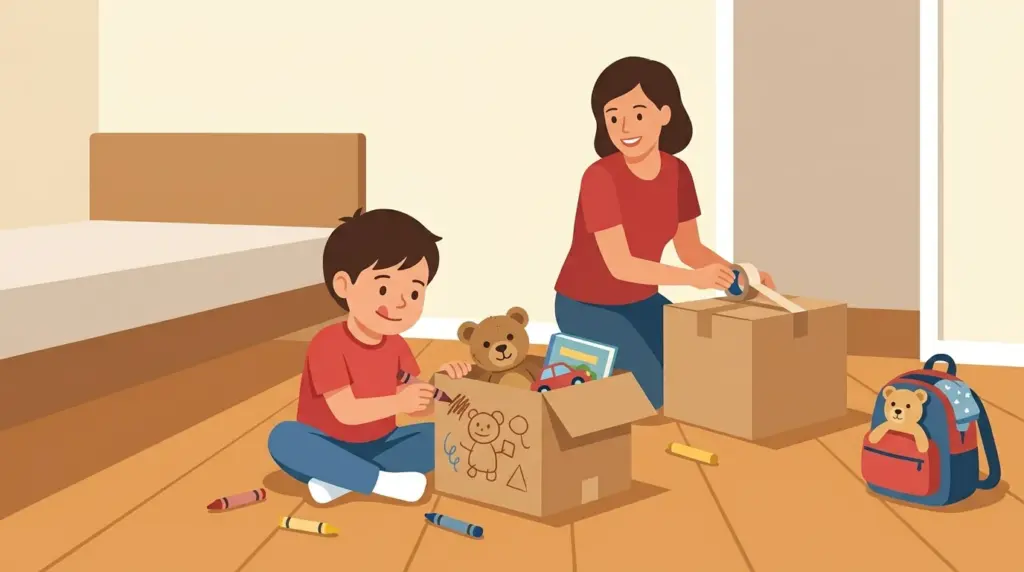
Keep the bedroom or familiar sleeping area intact until practical. Invite the child to choose what goes in a personal box, but have an adult check that medicines, important records, valuables, liquids, and fragile items are handled correctly. Photograph a beloved shelf or room arrangement if recreating it would be reassuring.
Pack a travel bag for the realistic journey and delivery window: clothes, medicines, comfort item, sleep supplies, snacks, water, headphones, chargers, activities, wipes, and any sensory or communication support. Do not rely on finding a specific box immediately after a long day.
Make moving day physically and emotionally predictable
Loading creates open doors, strangers, noise, tools, unstable stacks, and vehicles moving in limited space. The safest plan is often care away from the work with a trusted adult. If the child must remain on site, designate one adult whose only responsibility is the child and establish a room or area separated from the moving path.
Explain the day’s sequence the night before and again in the morning: who is arriving, where the child will be, when the family leaves, where they will sleep, and when familiar items return. Preserve meals, medicines, naps, and bedtime as closely as the day allows. A predictable ending matters more than a perfectly calm departure.
Use the first month to rebuild belonging
Children do not need a packed social calendar on arrival. Reestablish sleep, meals, school, care, and family time, then add manageable opportunities to connect. Walk the school route, learn the library or park, meet one neighbor, and help the child choose one familiar or promising activity.
Check in with specific questions: “Who did you sit near at lunch?” “What part of the day feels confusing?” “What do you miss most today?” Share useful observations with the teacher or caregiver and ask what they see. Expect some tiredness, irritability, clinginess, sadness, or testing of limits during a major transition without treating every response as a problem.
The American Academy of Child and Adolescent Psychiatry notes that moves can be difficult but can also support growth when families prepare and stay attentive. If distress is intense, persists, worsens, interferes with sleep, school, eating, relationships, or daily life, or raises a safety concern, contact the child’s pediatrician or a qualified mental-health professional. The goal is support, not a deadline for appearing settled.
For destination school decisions, use the guide to choosing a school district. Coordinate the household schedule with the complete moving checklist.
Sources
- Child Mind Institute: Advice for moving with children
- American Academy of Child and Adolescent Psychiatry: Children and family moves
- PBS Kids for Parents: Prepare a child for a new school
- U.S. Department of Education: FERPA and transferring records
- U.S. Department of Education: IDEA transfer provisions
- ChildCare.gov: Find and choose quality child care