

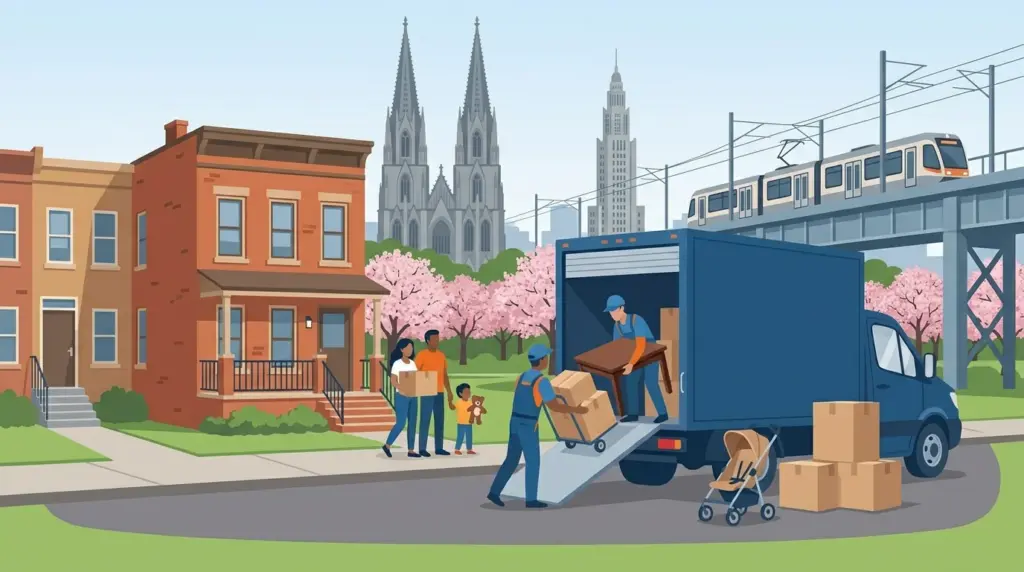
Start with the Newark life you want to build
Newark can place a household inside a major employment, university, airport, arts, and transportation center with direct connections to New York and much of New Jersey. The city works differently depending on the anchor. A job near Newark Penn, a university or hospital, an airport shift, and a Manhattan commute each point toward a different transit and neighborhood test.
Downtown, the Ironbound, University Heights, Forest Hill, and the South and West Wards offer distinct housing and travel patterns. Newark is a renter-majority city, so lease terms, building operations, parking, and moving access deserve as much attention as the advertised monthly price. The strongest choice is a home that supports the repeated trip without making every other household need difficult.
The New Jersey state guide covers statewide housing, utilities, taxes, and registration. This Newark guide focuses on city housing, transit orientation, and the curb-to-door details that change moving cost and daily life.
Turn Newark housing data into a usable budget
Zillow estimated typical advertised monthly rent in Newark at about $2,138 in April 2026. The Newark estimate combines advertised apartments and houses of several sizes, so use it as an opening budget rather than a one-bedroom or two-bedroom price.
In the same ACS data, 47.4% of rent-paying units spent at least 35% of household income on gross rent. That threshold signals limited budget room for many existing Newark renters.
Newark’s advertised-rent estimate should open the search, not finish it. Compare current homes with the same bedroom count, condition, lease length, utilities, parking, pet rules, broker or move-in charges, and transit access. In older multifamily buildings, confirm heat, electrical service, laundry, stairs, and pest responsibilities. In newer buildings, price amenities, parking, elevator reservations, and recurring fees.
Choose an area by testing the ordinary week
Start with the station or employment anchor, then compare the neighborhood around it. Newark’s wards are large, so the exact block, stop, building, parking zone, and night or weekend routine matter.
Build transportation around the exact address
NJ TRANSIT identifies Newark Penn as a hub for Northeast Corridor, North Jersey Coast, and Raritan Valley trains, with PATH, light rail, and bus connections. Newark Broad Street serves a different rail set. Choose the address around the line and station the household will actually use, then test the final walk or bus connection.
The citywide mean commute is long enough to make transfer and schedule quality important. A fast train matters less when the walk, wait, or final connection is unreliable for the household’s hours. Test weekday and weekend service, late returns, accessibility needs, and a backup route before signing a lease.
Price the move around Newark access
Newark’s dense blocks make the curb a real part of the estimate. The city’s traffic division provides a curb-loading-zone process, while individual buildings set their own elevator, insurance, and move-hour rules. Bring those facts together before booking so the truck, legal space, building reservation, and crew window match.
Moves from New York can be short in mileage and demanding at both ends. Share the origin and Newark building rules, stairs, long carries, parking, packing scope, and certificate requirements with every provider. Compare written estimates using one inventory and the same valuation and access assumptions.
Turn arrival into a good first Newark week
Confirm keys, building access, utilities, internet, parking, and the legal unloading position before the truck leaves the origin. Carry documents, medication, transit payment, work equipment, bedding, food, chargers, and a change of clothing separately.
Use the first week to rehearse the exact station or job trip, locate groceries and care, learn street-cleaning and refuse rules, and identify a late-night alternative. Newark’s transportation choice becomes a real advantage when the household knows which station, line, and local connection fit each recurring trip.
Questions that sharpen the Newark decision
Sources
- U.S. Census Bureau: 2020-2024 American Community Survey 5-Year Data
- FMCSA: Moving Checklist
- FMCSA: How to Understand and Compare Moving Estimates
- City of Newark: Division of Traffic and Signals
- NJ TRANSIT: Newark Rail, Light Rail and Bus Connections
- Zillow Research: Housing Data and ZORI methodology