

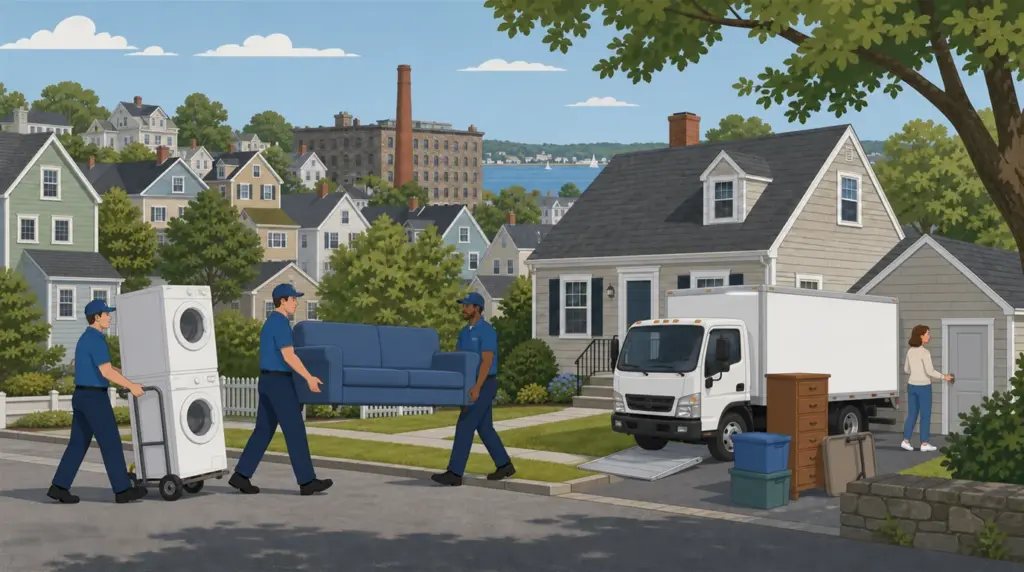
Cranston can look like one close-in Providence suburb on a regional map, but the city contains three different daily realities. Eastern neighborhoods are denser and closer to Providence, central Cranston revolves around commercial corridors and highway connections, and western Cranston has larger lots, more open land, fewer transit options, and a stronger dependence on a car. Choosing the wrong side for your routine can erase a small housing saving in time, transportation, or property costs.
This guide helps you compare those parts of Cranston before comparing individual homes. It establishes a consistent housing baseline, connects neighborhoods to commuting, schools, parks, and services, identifies flood and property-system questions, and turns the chosen address into a realistic moving price and arrival sequence. The aim is to make the address—not the city name—the basis of the decision.
Use Cranston’s housing figures as a baseline, not a listing price
Cranston’s 2020–2024 median owner-occupied home value was $378,300, and median gross rent was $1,375. Median monthly owner costs for a home with a mortgage were $2,202. These Census measures make unlike places easier to compare historically; they do not tell you what an available apartment or house costs now. Gross rent can include some tenant-paid utilities, while an advertised rent may leave out heat, electricity, parking, pets, or mandatory fees.
The same period shows a 67.6% owner-occupied housing rate. Cranston includes older urban housing, postwar neighborhoods, apartments, and lower-density western properties, so one citywide median can hide more than it reveals. Compare current homes with the same bedroom count, condition, parking, and lease terms. Then add taxes or fees, insurance, utilities, transportation, and the actual property’s roof, electrical system, heat, basement moisture, sewer connection, drainage, and access.
The statewide comparison makes the limit especially clear: Cranston’s historical median gross rent was only $12 above Warwick’s and $33 below Providence’s. One current listing, utility history, parking arrangement, or commute can outweigh that difference. Use the Warwick guide for airport-and-bay comparisons and the Providence guide for a denser rail-and-university alternative.
Choose eastern, central, or western Cranston before choosing a street
Cranston’s adopted comprehensive plan describes an urbanized east, a suburban and commercial middle, and a lower-density west with open space and greater car reliance. That distinction is more useful than a long neighborhood list. Start with the trip that cannot move—work, school, care, transit, or family support—then test the address at the relevant hour.
Use Cranston’s official GIS and tax maps to confirm parcel, zoning, and municipal information. A mailing label or neighborhood name does not establish school assignment, utilities, flood status, or road responsibility. Visit after rain and during the commute, measure the route from the legal truck position to every room, and ask the owner or manager to put parking, storage, pet, utility, and move-in rules in writing.
Connect the address to Providence without assuming every trip is easy
I-95 runs along eastern Cranston, I-295 serves the western side, Route 10 links toward Providence, and Route 37 crosses between I-95 and I-295. Reservoir Avenue is also a major commercial corridor. Those roads create options, but they concentrate traffic at different points. Test the full route at the actual start and return times instead of treating Providence mileage as a commute estimate.
RIPTA Route 21 currently connects CCRI Warwick, Garden City, Reservoir Avenue, and Kennedy Plaza, with weekday and weekend schedules. Other eastern and central corridors have additional service, but western Cranston is more car-dependent. Check the live system map, the walk to the stop, transfer, last feasible return, and weekend schedule. Commuter-rail trips generally begin at Providence Station or the airport InterLink in Warwick, so include the trip to the station, parking, and timetable in the comparison.
For K–12 education, use Cranston Public Schools’ current school list and registration process rather than a property portal’s boundary display. The Cranston Area Career and Technical Center spans two campuses and currently describes 16 programs with hands-on training, certifications, and some college-credit opportunities. Higher-education routines may point toward Providence institutions or CCRI’s Knight Campus in Warwick. Program fit matters, but so does the daily route from the exact home.
Check flood, parking, and property systems before the truck is booked
Cranston’s flood questions are not limited to the coastline. The city’s hazard planning and Pocasset River work identify river, brook, drainage, and stormwater concerns in several developed areas. Check the current parcel in the city GIS and FEMA map, then ask for any elevation information, prior water-entry or insurance claims, drainage work, sump-pump history, and the route used during severe weather. A nearby home may have a different elevation or drainage pattern.
Parking is a moving-day issue in denser neighborhoods. Cranston’s current notice says overnight street parking is always prohibited, and the city can impose broader parking bans for snow. That does not automatically reserve daytime curb space for a truck. Ask the property manager and city about the exact legal position, hours, building rules, and any temporary restrictions. Recheck city alerts when snow is possible; a ban can also delay trash service and narrow the street even after a storm.
Cranston provides weekly curbside collection to eligible one- through four-family homes using city carts. Bulky waste is handled separately and normally requires scheduling and a fee, with limited free programs at certain times. Do not leave unwanted furniture beside the carts without confirming the current program. Decide what will be sold, donated, recycled, scheduled for pickup, or removed privately before the mover prices the shipment.
Price a Cranston move from the belongings and both properties
There is no single average price for a Cranston move. The useful number depends on the inventory, origin, destination, date, crew, services, and access at both ends. These local examples show how home size changes an early planning range before optional services and property complications are included.
| Example local move | Moveline early price range |
|---|---|
| Studio or lightly furnished one-bedroom | $400–$550 for an example 10-mile move with about 1,800 pounds of belongings. |
| Two-bedroom home | $800–$1,100 for an example 10-mile move with about 5,000 pounds. |
| Three-bedroom home | $1,250–$1,700 for an example 10-mile move with about 8,000 pounds. |
Moveline’s estimator combines aggregated moving-price patterns with route distance and estimated shipment weight. These examples were calculated for September 15, 2026, then rounded and widened into readable ranges. They are not quotes. Packing, stairs, an elevator, a long carry, older doorways, heavy items, Route 2 or I-95 traffic, a smaller transfer vehicle, storage, snow, and a difficult western driveway can change the total. Use the Moveline calculator for the real route, then compare written estimates based on the same inventory and services.
A move entirely within Rhode Island is regulated differently from one that crosses the state line, even if Massachusetts is only a short drive away. The Rhode Island Division of Public Utilities and Carriers licenses intrastate household-goods movers and approves tariffs. For an interstate move, use FMCSA Protect Your Move to verify registration, carrier or broker status, complaint information, and the company expected to transport the shipment. Use the estimate comparison guide to compare the complete scope.
Turn the selected Cranston address into an arrival sequence
The main Rhode Island DMV office is itself in Cranston, but proximity does not replace preparation. Check whether an appointment is needed and bring the exact current forms, identification, ownership or lien documents, residency proof, insurance, and VIN paperwork. The broader Moving to Rhode Island guide covers statewide taxes, electricity, coastal comparisons, and arrival requirements. The city moving-guide directory helps compare Cranston with other destinations.
Cranston moving questions
Is eastern or western Cranston better?
Neither is universally better. Eastern Cranston offers greater Providence proximity, density, and transit access; western Cranston offers more open space and lower-density housing but greater car dependence. Choose from the recurring trip, property systems, and access you need.
Is Cranston cheaper than Providence or Warwick?
The consistent 2020–2024 median gross-rent baseline was $1,375 in Cranston, $1,408 in Providence, and $1,363 in Warwick. That narrow range cannot establish today’s value. Compare current same-bedroom homes, utilities, parking, transportation, insurance, and condition.
Can I park a moving truck overnight on a Cranston street?
Cranston’s current city notice says overnight street parking is prohibited. Do not assume a truck is exempt. Arrange the delivery during approved hours and confirm the exact legal position and any temporary restrictions with the property manager and city.
Is Cranston practical without a car?
Some eastern and central addresses can work with RIPTA and short Providence trips, especially when the daily destinations align with a corridor. Western Cranston is more car-dependent. Test every required trip, its return schedule, groceries, school, and bad-weather alternative.
Sources
Official sources and time-sensitive information were reviewed August 3, 2026. Use the live agency page for current maps, schedules, forms, fees, and rules.
- U.S. Census Bureau QuickFacts: Cranston
- City of Cranston: 2024 Comprehensive Plan, Planning and GIS access, Pocasset River flood project, and parking notice
- City of Cranston: curbside refuse and bulky and special waste
- RIPTA Route 21 schedule and RIPTA system map
- Cranston Public Schools and Cranston Area Career and Technical Center
- Rhode Island DMV: moving from out of state
- Rhode Island PUC: for-hire property carriers and FMCSA Protect Your Move