

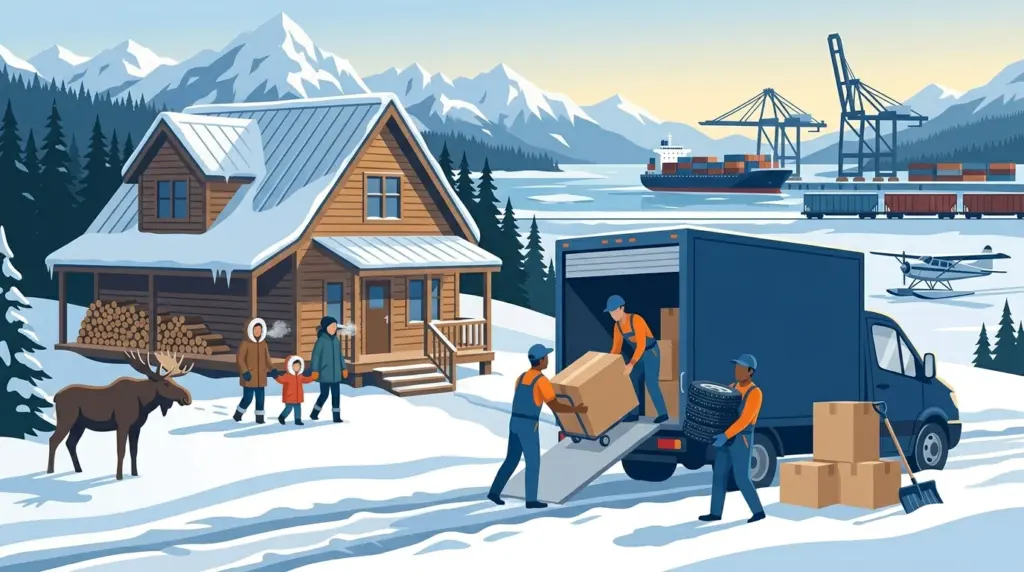
Design the Anchorage move around everyday life
Anchorage can provide an urban Alaska base with major health care, government, logistics, cultural institutions, and immediate access to an extraordinary landscape. Relocating there also asks for a different level of coordination: the household, vehicles, essential belongings, and the main shipment may not all travel on the same schedule or by the same mode.
Start with the life that must function on day one. Decide which belongings travel with people, which can move by highway or marine service, and how long the household can operate before everything arrives. Housing, heat, winter access, and the full custody chain then become one plan rather than separate last-minute decisions.
Choose an Anchorage transport plan that protects the first weeks
An Anchorage move is a transport-design problem before it is a price-comparison problem. The 2025 population estimate was 287,155, April 2026 ZORI was about $1,698, and the ACS median household income was $103,284. Those figures help with the destination budget, but they do not choose between driving through Canada, commercial highway service, or marine/container transport.
The correct mode depends on vehicle plans, prohibited or sensitive goods, delivery tolerance, season, origin, and whether the household needs the shipment immediately. A quote with a low transportation total can still fail if it strands work gear, winter clothing, documents, or housing essentials in the wrong stream.
Use the statewide moving guide for Alaska-wide context and the ultimate moving checklist for the overall move. Anchorage needs an additional layer: split the household into what travels with people, what travels with a carrier, and what can arrive later.
Housing figures are only one budget layer
The ACS median gross rent was $1,489 for 2020–2024, while the newer ZORI index was about $1,698. They do not form a clean rent-growth series. Price the exact unit, heat and utilities, parking, storage, deposit, winter access, and any period of housing overlap.
The ACS estimated 11,704 residents age 1+ had lived in another state one year earlier. That demonstrates interstate mobility, not a representative shipping pattern. Do not use a small internal lead sample to claim how Anchorage movers usually ship.
Choose the transport architecture first
A self-drive or personally towed load through Canada requires border readiness. CBSA advises non-residents personally transporting household effects in transit to prepare a triplicate list with values and identifiable serial numbers; sealing or a security deposit may be required in some situations.
Commercial highway carriers moving U.S. domestic goods through Canada have a different process: CBSA says the carrier must be bonded or obtain single-trip authorization, with transit documentation. That is the carrier’s operational responsibility, but the customer should verify the provider has a compliant plan.
Marine or container service avoids a household driving the entire Alaska Highway but changes pickup, terminal, container, vehicle, delivery, and timing questions. Compare door-to-door scope, not a port-to-port headline.
Winter changes the arrival sequence
Anchorage’s Snow HQ explains that residential plowing follows arterials and collectors and that neighborhood clearance time grows with snowfall. It also distinguishes municipal and state-maintained roads. A cleared highway does not prove the destination street, driveway, stairs, or storage area is usable.
Ask the landlord or seller who clears the driveway, walkway, stairs, roof access, and parking area. Keep cold-weather clothing, medication, traction equipment, and essential work gear out of any shipment whose delivery date can move.
Stage Anchorage rather than arriving all at once
The first shipment should make the household safe and functional, not complete. Confirm heat, utilities, keys, winter access, food, medicine, communication, and a place for delayed goods before optimizing furniture timing.
Use how to choose a moving company to compare the actual custody chain: pickup carrier, border or port handling, storage, final delivery, exclusions, and claims contact. A provider that cannot name the chain is not ready to carry the move.
Questions that sharpen a Anchorage move
Sources
- Municipality of Anchorage: Snow HQ
- Canada Border Services Agency: Domestic In-Transit Shipments
- Canada Border Services Agency: U.S. Goods in Transit Through Canada
- U.S. Census Bureau: 2024 ACS 5-Year Data
- U.S. Census Bureau: Vintage 2025 City and Town Population Estimates
- FMCSA: Estimating Charges
- FMCSA: Moving Checklist
- Zillow Research: Housing Data and ZORI methodology
- U.S. Census Bureau: Gross rent definition