

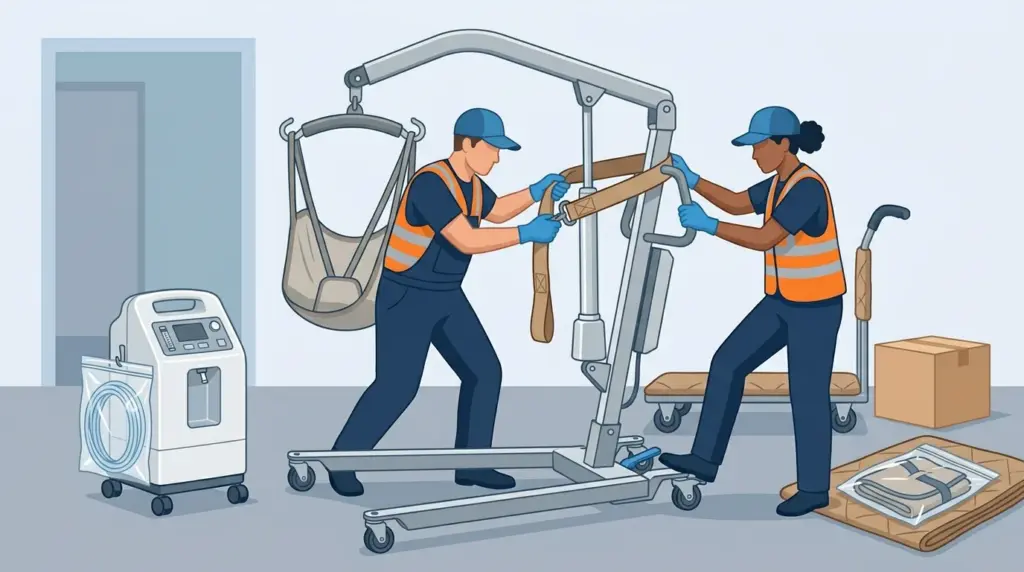
Moving medical equipment is not one hauling job. A mover may be able to carry an empty prepared bed or boxed device, but that does not qualify the crew to maintain a patient’s care, prescribe oxygen, choose a sling, disconnect a clinical system, ship a hazardous cylinder, or certify that a powered device is safe to use again.
This guide separates care continuity, supplier or technician work, regulated transport, ordinary moving work, and arrival testing. Use it to assign each handoff in writing before the old setup is taken apart, with the exact device manual and the patient’s clinician or durable-medical-equipment provider controlling device-specific decisions.
Start with ownership, prescription, and service area
Record the manufacturer, exact model, serial number, owner, prescribing clinician, supplier, current settings, accessories, consumables, power requirements, battery type, service contact, and replacement value. Photograph the working setup and labels without exposing private medical information to people who do not need it. If the equipment is rented, leased, insurer-provided, or supplier-owned, do not relocate it until the owner says how.
A supplier may need to retrieve equipment and deliver an equivalent unit at the destination, especially when the destination is outside its service area. Coverage, authorization, network, and replacement arrangements are health-care questions; a moving quote does not answer them.
Oxygen is not ordinary household cargo
FMCSA’s household-goods guidance identifies oxygen bottles as hazardous material. Do not hide or casually pack compressed oxygen cylinders or liquid oxygen with furniture and cartons. Disclose the exact product to the performing carrier and oxygen supplier; they must decide whether they can lawfully accept it, under what packaging and documentation, and whether supplier exchange or destination delivery is the correct solution.
Oxygen also changes the fire environment. The FDA warns that oxygen enrichment increases the risk that an electrical fault or other ignition will start a fire, and the National Fire Protection Association’s medical-oxygen guidance calls for strict separation from smoking, open flames, heat, and incompatible materials. Follow the current equipment label, supplier instructions, and local fire-safety rules at both homes.
Air travel follows a separate rule set. FAA states that passengers may not bring their own compressed or liquid oxygen cylinders in baggage; an airline may provide oxygen service. Portable oxygen concentrators have separate acceptance and battery rules. Coordinate with the airline, clinician, and equipment provider well in advance—never assume a household-goods plan works on an aircraft.
Powered devices and batteries need an operating plan
List normal power, charger, approved battery, battery runtime, surge or grounding requirements, alarm behavior, environmental limits, and what happens when power fails. FDA’s home-device guidance emphasizes backup planning because settings can reset and damaged cords or batteries can make a device unsafe. A generator, inverter, extension cord, or third-party battery is not acceptable merely because the plug fits; use only configurations allowed by the current manufacturer instructions and care plan.
For air travel, FAA requires spare batteries to be protected from short circuit and generally carried in the cabin, subject to chemistry, watt-hour limits, device rules, and airline procedures. Damaged or recalled batteries can be forbidden. For road transport, ask the device maker, supplier, and carrier about temperature, orientation, impact protection, and battery isolation rather than inventing a generic packing method.
Beds and lifts require exact-model work
For a hospital bed, use Moveline’s separate model-specific hospital-bed guide. That article covers the bed itself; this page covers the broader medical-equipment handoff. The bed should be unoccupied before ordinary moving work begins, and only the owner, provider, manufacturer instructions, or authorized technician should determine disassembly and service steps.
For patient lifts, FDA stresses training, inspection, the correct sling for the lift and patient, and adherence to weight limits. Do not let a moving crew improvise with a sling or perform a patient transfer. Bagging a sling with the lift is useful for identification, but a trained caregiver or provider must confirm compatibility and condition before the next transfer.
What the written moving scope must say
Build the arrival test before loading day
- Prepare the destination room: electrical capacity, grounded outlets, space, ventilation, floor loading, lighting, egress, fire separation, and supplier access.
- Schedule the provider or authorized technician independently of the household truck, with enough margin for delay.
- Keep essential devices, medications, consumables, manuals, contacts, and approved backup power with the care team—not buried in the shipment.
- Inspect delivered equipment for impact, moisture, loose parts, damaged cords, alarms, missing accessories, and label mismatches before energizing it.
- Have the responsible qualified person restore settings, connections, accessories, and prescribed configuration, then perform the manufacturer-required checks.
- Do not place the person in a bed, lift them, or depend on the device until the care team accepts the setup.
Choose a mover for the transport portion—not the clinical portion
Ask general movers what they exclude and what similar empty equipment they have transported, but do not treat experience as clinical authorization. A specialty mover may offer rigging or high-value handling; it still needs a clear boundary with the manufacturer, DME supplier, clinician, biomedical technician, electrician, fire authority, or other qualified professional.
Use Moveline’s moving-company questions to compare the commercial terms. Add the equipment matrix, route measurements, responsible-party list, and arrival acceptance test to the quote request so every bidder prices the same safe scope.
Sources
- FMCSA — Hazardous materials in household moves
- FDA — Patient lifts
- FDA — Unique considerations for home medical devices
- FDA — Emergency tips for medical devices
- FAA — Compressed or liquid oxygen
- FAA — Portable oxygen concentrators
- FAA — PackSafe battery and hazardous-material guidance
- NFPA — Medical oxygen safety