

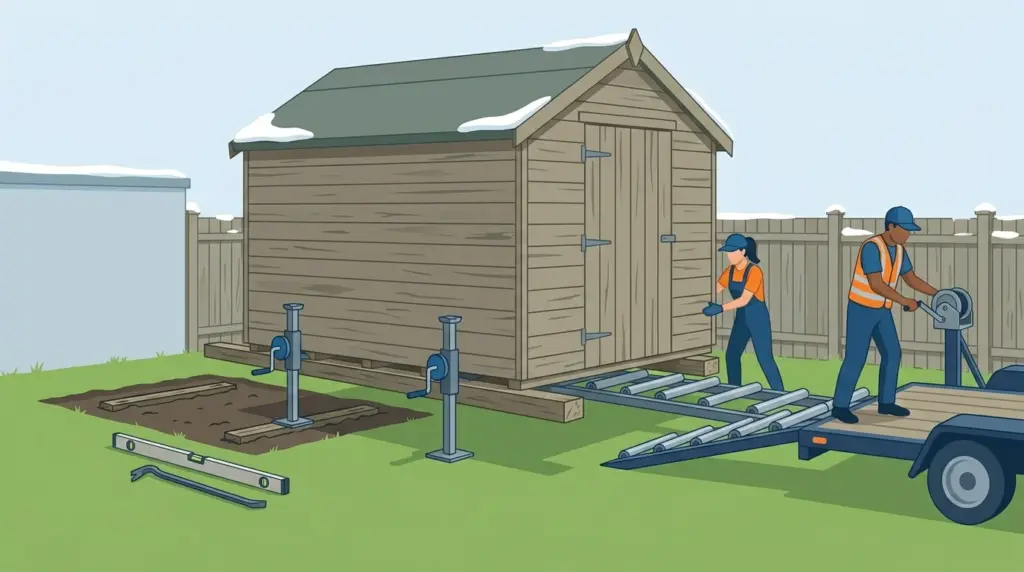
Moving a shed is challenging because the structure must be lifted without twisting or breaking, carried across ground that can support the equipment, and placed on a level foundation at the destination. Fences, slopes, soft soil, trees, overhead lines, utilities, narrow streets, and permit requirements can turn a short relocation into a specialized transport job.
This guide will help you determine whether the shed can move intact, measure the structure and complete route, identify the permits and equipment the move requires, prepare the new site, and recognize when an experienced shed mover is the safest and most economical choice.
First decide whether the shed should move intact
Inspect the foundation, floor frame, wall framing, roof, doors, windows, and connections between sections. Look for rot, insect damage, loose siding, cracked framing, water damage, and repairs that may separate under lifting. Empty the shed completely so tools and materials cannot shift inside.
Compare the cost of moving with the cost of careful disassembly, rebuilding, or replacement. A well-built shed with good access may be worth relocating. A weakened structure, permanent masonry work, or a route that requires major property changes may point to another solution.
| Move type | Typical planning need | Best help |
|---|---|---|
| Small shed, short distance on the same property | Sound frame, clear level path, suitable lifting and rolling equipment | Experienced shed mover or qualified local contractor |
| Move through a gate, slope, soft yard, or tight turn | Exact measurements, ground protection, equipment access, and recovery plan | Professional with the right lift and transport equipment |
| Move on a public road | Transport dimensions, permits, legal route, securement, and traffic requirements | Licensed structure or oversize-load specialist |
| Large, damaged, wired, plumbed, or permanently anchored shed | Structural review and lawful utility disconnection | Contractors for structure, utilities, and transport |
Measure the shed and the full route
Record exterior length, width, height, roof overhangs, foundation clearance, weight if known, and the strongest lifting points identified by the builder or a qualified professional. Measure the route at its narrowest and lowest points, not just the starting and ending spaces.
Check gates, fences, trees, branches, eaves, utility lines, slopes, soft soil, drainage, septic areas, retaining walls, neighboring property, street access, and the space needed for a trailer, forklift, crane, or other equipment. The loaded height includes the trailer or supports beneath the shed.
Clear permits, ownership, and utility work
Ask the local building or zoning office about removal, relocation, foundation, setback, and destination requirements. A road move may also need oversize permits, an approved route, travel-time restrictions, warning equipment, or escorts. Rules depend on the shed and every jurisdiction along the route.
Have qualified professionals disconnect electricity, plumbing, gas, data, solar equipment, or other services. Confirm underground lines before preparing the destination or equipment path. Do not lift or drag a shed that is still anchored or connected.
Prepare the destination before move day
The new location needs approved setbacks, drainage, access, and a level foundation that matches the shed and local requirements. Prepare gravel, blocks, piers, slab, anchors, or another specified base before the structure arrives. Confirm how the shed will transfer from transport equipment to the finished supports.
Plan door orientation, roof drainage, future maintenance access, electrical service, and the surrounding grade. A successful move ends with a square, level, supported, and anchored shed—not a structure left on temporary rollers while the base is finished.
Request an equipment-specific written price
Give each company the same dimensions, photographs, condition notes, origin route, road distance, destination access, base design, utility status, and requested date. Ask what equipment will lift, carry, and place the shed; who obtains permits; who removes or replaces fences; and what happens if the ground will not support the equipment.
Confirm whether the price includes preparation, bracing, lifting, loading, permits, road transport, escorts, unloading, leveling, anchoring, and cleanup. Ask about protection for the shed, both properties, underground services, and third-party damage. Moveline’s questions for moving companies can help document these responsibilities.
Use professional help when control is uncertain
A shed move involves a heavy structure with a high center of gravity. Slopes, soft ground, tight clearances, public roads, overhead lines, weak framing, or improvised lifting can quickly exceed a household project. Choose a professional when the shed cannot remain level and supported or when the equipment path is not clearly safe.
Even for a same-yard move, the right machinery can protect the structure, lawn, fence, and people. A professional can also recognize when reinforcement, disassembly, or a crane is more appropriate than rolling the shed intact.
Coordinate move day and final placement
Keep people, pets, vehicles, and loose materials outside the work area. Confirm weather and ground conditions, access to both sites, utility clearance, permit documents, and the destination base before equipment arrives. Assign one owner contact to approve placement and answer questions.
After placement, check that the shed is level, square, fully supported, anchored, weather-tight, and operating properly at doors and windows. Complete utility reconnection through the appropriate professionals and follow any required inspection process.