

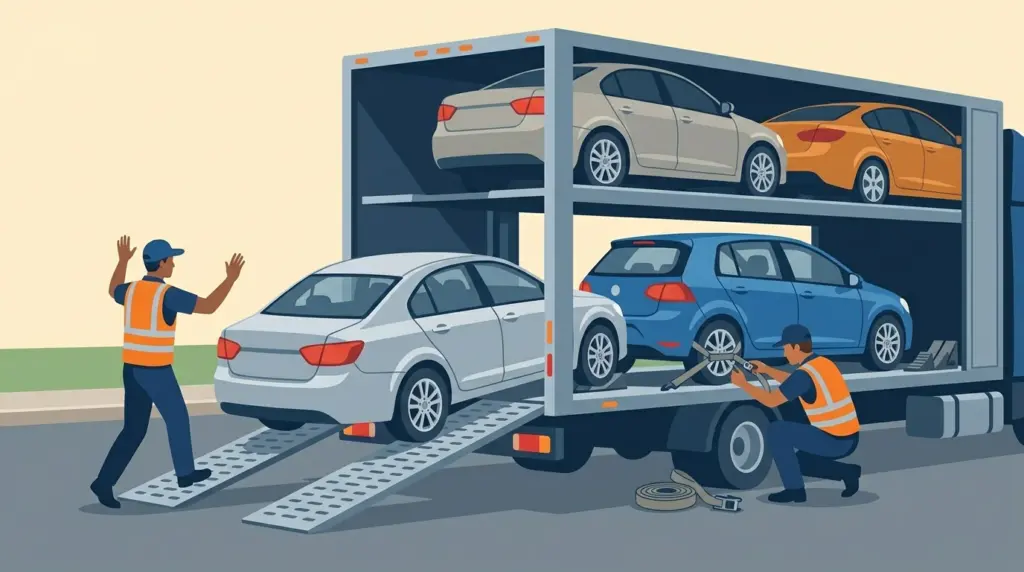
Shipping a car is challenging because the first price you see may be a broker’s estimate, not a carrier-accepted price for the exact vehicle, route, dates, and pickup conditions. A low number can change when the car is oversized or inoperable, the address cannot accommodate a transport truck, or the requested pickup window is too narrow.
This guide will help you set a realistic 2026 price range, choose open or enclosed transport, prepare the vehicle, compare complete written offers, and verify the company responsible for arranging and performing the shipment.
How much does it cost to ship a car in 2026?
Published 2026 consumer examples commonly place standard domestic car shipments around $500 to $1,600. Short, flexible open-carrier moves can land near the lower end; cross-country, enclosed, oversized, expedited, or hard-to-serve moves can exceed the upper end. The useful price is the written offer for your exact car and route.
| Example shipment | Useful starting range | Main reason it can change |
|---|---|---|
| Short regional move, open carrier | $500–$900 | Minimum dispatch cost and endpoint access |
| Medium-distance move, open carrier | $700–$1,200 | Route demand, vehicle size, and pickup window |
| Cross-country move, open carrier | $1,000–$1,600+ | Distance, lane balance, fuel, and carrier availability |
| Enclosed or specialty shipment | Usually higher than open | Limited equipment and additional protection |
These are research ranges, not guaranteed rates. Compare offers collected on the same day with the same vehicle, transport type, addresses, and timing.
Open transport costs less; enclosed transport protects more
Open carriers move most ordinary vehicles and are usually the economical choice. The car is exposed to weather and road conditions, much as it would be while driving. Enclosed carriers shield the vehicle and often use lower-capacity equipment, so they are a strong fit for collectible, restored, exotic, very low-clearance, or high-value cars.
Ask how the car will be loaded, whether low-clearance equipment is available, and what belongings—if any—may remain inside. Do not assume household items are allowed or protected. Moveline’s open-versus-enclosed guide helps match the service to the car.
The route and vehicle shape the price
Distance matters, but popular carrier lanes, direction, season, fuel, weather, and the number of vehicles moving in each direction also influence acceptance. A rural address or restricted city street may require a safe meeting point near a major road. A large pickup, modified SUV, non-running car, or vehicle with low ground clearance needs more space or equipment than an operable sedan.
Send the year, make, model, dimensions, running condition, modifications, ground clearance, exact ZIP codes, and workable pickup window to every company. This prevents one offer from looking cheaper simply because it describes an easier car or a wider schedule.
Know whether you are hiring a broker or carrier
An auto-transport broker arranges transportation; a motor carrier owns or operates the truck. The Federal Motor Carrier Safety Administration advises consumers to identify the company’s role and verify federal registration. The agreement should name the broker, explain the deposit, and identify the carrier before pickup.
Search the exact legal name, USDOT number, and MC number in the federal record. Confirm that the company shown on the payment request matches the company on the contract. Ask when a carrier has accepted the shipment and what happens to the deposit if no carrier accepts it.
Compare the complete written offer
- Is the amount a broker estimate or a carrier-confirmed price?
- Does it cover door-to-door service or an alternate meeting point?
- Is open or enclosed equipment named in writing?
- Are the deposit, remaining balance, payment method, and cancellation terms clear?
- What carrier liability applies, and how is preexisting damage documented?
- Are an inoperable vehicle, oversize charge, storage, redelivery, or expedited pickup extra?
Use Moveline’s car-shipping protection guide before choosing coverage or signing the inspection report.
Prepare the car for pickup and delivery
Remove personal valuables and prohibited items, reduce the fuel level as instructed, check fluids and tires, disable alarms, secure loose accessories, and photograph every side of the clean vehicle. Keep one key ready for the carrier. At pickup, review the condition report before signing; at delivery, inspect the car in good light before accepting the final condition.
If the carrier cannot safely enter either street, agree on a nearby legal location with enough turning and loading room. Traffic, low branches, weight limits, apartment rules, and city parking restrictions can make curbside loading impossible even when the quote says door-to-door.
Choose the offer that can actually perform the job
The best offer is not automatically the lowest. A credible company explains its role, uses matching federal identifiers, writes down the service and payment terms, communicates a realistic window, and identifies the performing carrier. Save the quote, contract, carrier details, inspection reports, photographs, and payment records together.
For a household move plus vehicle shipment, compare the car booking separately from the household-goods estimate. Moveline’s mover questions and company-verification guide cover the household side.