

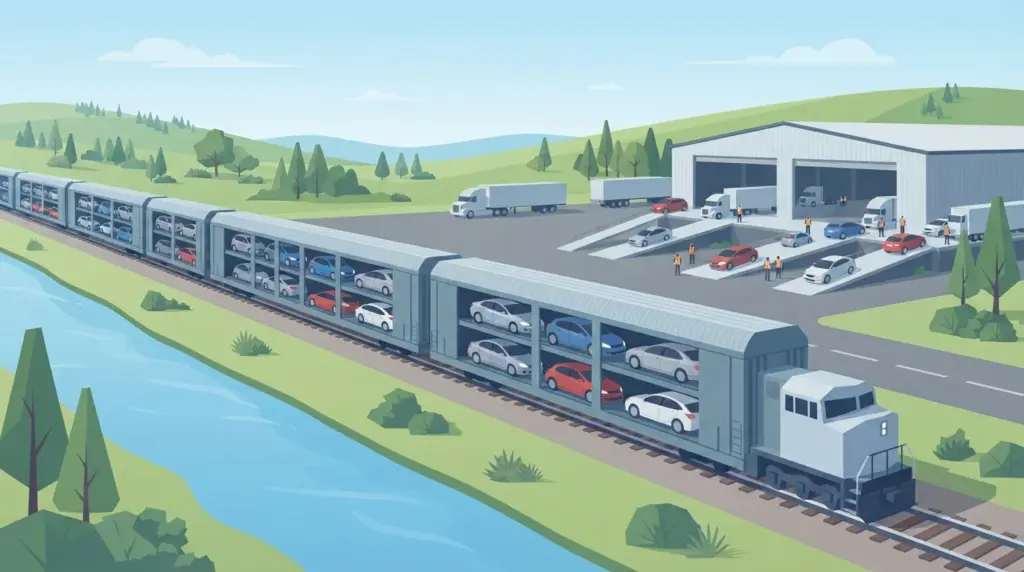
Shipping a car by train is challenging because the only practical U.S. passenger option for a privately owned vehicle is Amtrak Auto Train, where the traveler and car ride together between Lorton, Virginia, and Sanford, Florida. The drive to both stations, passenger fare, vehicle eligibility, check-in schedule, and remaining road travel determine whether the train actually improves the trip. Most other routes require a licensed road-transport company.
This guide will help you confirm whether Auto Train fits your route and vehicle, calculate the complete rail journey, compare it with road transport, prepare the car for a documented handoff, and choose the option that makes the entire relocation easier.
Check the route before comparing prices
Auto Train connects the Washington, D.C., region with central Florida. It can be an excellent alternative to driving the busiest part of Interstate 95, especially when the traveler wants their own car at the destination. It is not a network of stations where a car can be dropped off in one city and collected in another.
Start with the drive from your actual addresses to Lorton and from Sanford to the final destination. Add the passenger’s schedule, vehicle check-in time, overnight train ride, arrival process, and the driving still required at each end. A household moving from New York to Miami, for example, must still reach northern Virginia and complete the Florida portion after unloading.
| Situation | Best option to price first | Reason |
|---|---|---|
| You are traveling between the Mid-Atlantic and Florida | Amtrak Auto Train | The route may replace a long I-95 drive while keeping you and the car together |
| The car must travel without its owner | Road vehicle transport | A licensed company can collect and deliver the vehicle without a passenger rail ticket |
| The origin or destination is far from both Auto Train stations | Compare both complete trips | The extra driving, time, lodging, and fuel may remove the rail advantage |
| The vehicle is unusually tall, low, modified, or inoperable | Confirm eligibility before booking | Both rail and road services have equipment and loading limits |
Build the complete Auto Train price
The rail total can include a passenger fare, the vehicle charge, an optional room, optional priority unloading, and flexible or refundable fare choices. Fares and availability change by travel date, so use a live Amtrak itinerary instead of an old national average.
Add the cost of reaching Lorton, leaving Sanford, meals outside the included service, a hotel if the station schedule does not fit the household’s plan, and the value of the traveler’s time. Compare that total with driving and with a current road-transport quote for the same vehicle and dates.
Confirm that the exact vehicle qualifies
Use Amtrak’s current vehicle-requirements page before paying. Measure the vehicle as it will arrive, including roof racks, cargo boxes, antennas, spoilers, running boards, wide tires, or other modifications. Confirm requirements for motorcycles, trailers, dual-wheel vehicles, ground clearance, and any removable accessories directly with Amtrak.
The vehicle must also be ready to load and operate as required. Do not assume a non-running car, active fluid leak, weak battery, or temporary repair will be accepted. If the measurements or condition are close to a limit, obtain confirmation before travel day.
Compare road transport on the same facts
For road transport, request the total for the exact year, make, model, operating condition, pickup area, delivery area, dates, and open or enclosed service. Ask whether the company owns the truck or arranges transportation with another company. Both interstate vehicle transporters and companies that arrange the service must have the appropriate federal registration.
Moveline’s guide to open and enclosed car shipping explains the protection and fit differences. Also review car-shipping insurance and inspection records before handing over the keys.
Prepare a clean, load-ready car
Remove loose belongings and prohibited items, reduce unnecessary cargo, turn off alarms, and keep the fuel level within the service’s current requirement. Photograph every side, the roof, wheels, glass, interior, and odometer in good light. Keep travel documents, medication, keys, chargers, and anything needed immediately with the traveler.
At a road pickup, review the vehicle-condition report with the driver before signing it. At Auto Train, follow the station’s check-in and vehicle instructions exactly. The goal in either case is a clear handoff record and a vehicle that can be loaded without delay.
Plan the arrival, not just the departure
Auto Train arrival includes unloading many vehicles, so keep the next appointment flexible. For road transport, the delivery location must safely accommodate the truck; a driver may need to meet you at a wider nearby street or parking area. Inspect the vehicle before accepting delivery and record any new damage on the delivery paperwork before signing.
Choose train when it improves the whole journey
Auto Train is most compelling when the traveler is already moving between its two regions, wants their own vehicle immediately, and values avoiding a long highway drive. Road transport usually wins when the car must move alone, the route is elsewhere, or the household needs flexible pickup and delivery. Price the complete trip both ways and choose the one that makes arrival easier.